
Indian Cooking for Beginners: A Dutch Kitchen Guide
In short: Indian cooking for beginners comes down to ten ingredients and three techniques: tadka (tempering spices in hot fat), the slow-cooked onion-tomato base called bhuna, and adding ground spices with moisture so they never burn.
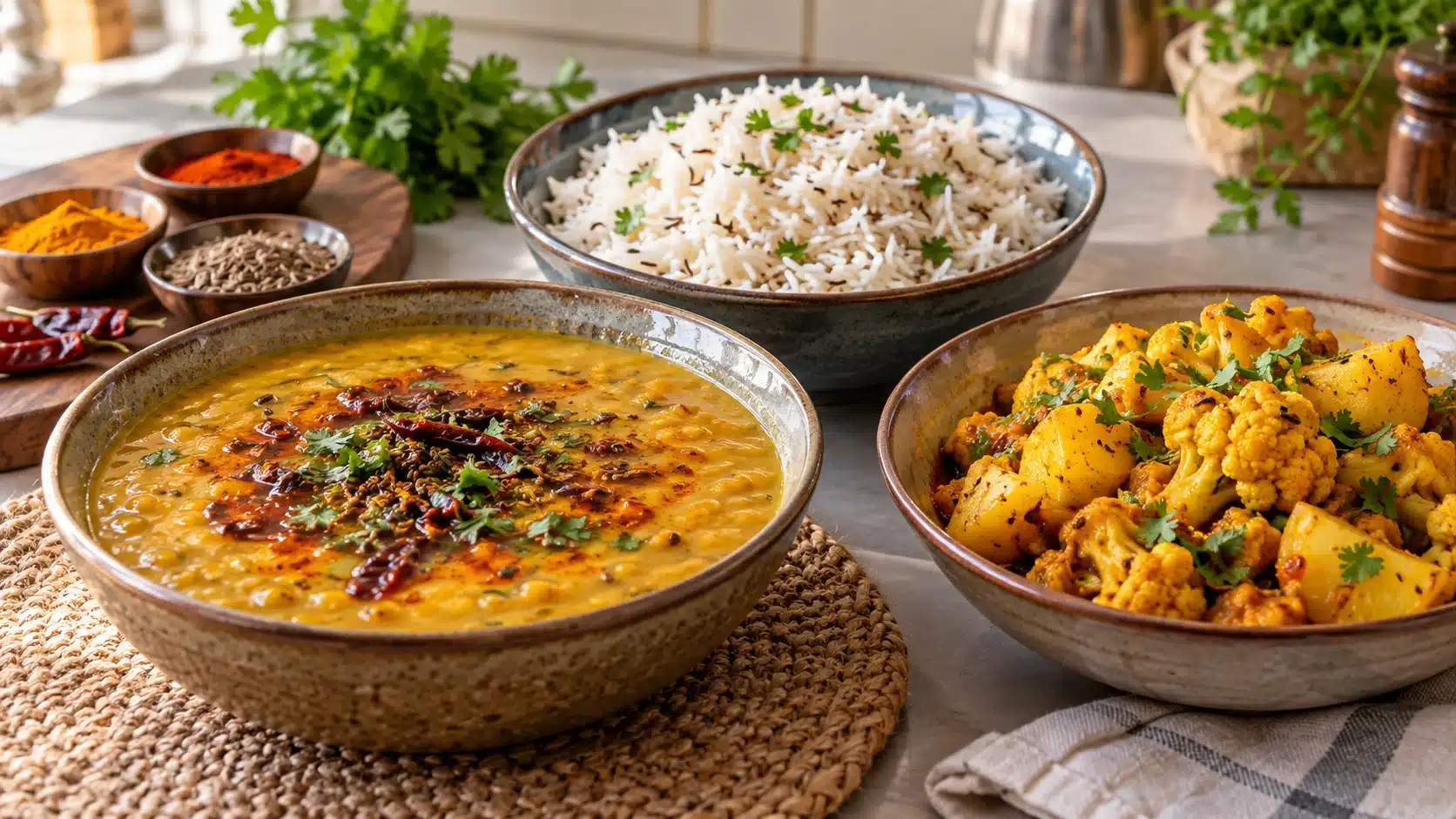
Cook dal tadka, then jeera rice, then aloo gobi, in that order, and each dish teaches what the next one needs.
Open an Indian cookbook and the ingredient lists look endless: fourteen spices for one curry, three kinds of dal, a paste you are meant to grind yourself.
It is easy to conclude that the cuisine needs a specialist pantry and years of practice.
It does not.
Most everyday Indian home cooking runs on a small set of ingredients and a few repeated movements.
Learn those, and the long recipes turn out to be variations on things you already know.
The three techniques that make everything else work
Tadka, or tempering
Heat a spoonful or two of fat, add whole spices such as cumin seed or mustard seed, and let them sizzle for seconds until fragrant.
That flavoured fat is either the start of a dish or is poured over a finished one.
It is the technique behind almost every dal and many vegetable dishes.
The key is time: seconds, not minutes.
When cumin turns a shade darker and smells nutty, it is done.
A few seconds more and it is bitter.
Our guide on how to build a spice rack explains tadka step by step.
The onion-tomato base, or bhuna
Most North Indian curries start the same way.
Onions are fried slowly until deep golden, ginger and garlic go in, then tomatoes, and the whole lot cooks down until the oil separates and shines at the edges of the pan.
That is bhuna, and it becomes the sauce.
It needs patience: 15 to 20 minutes for the onions alone.
Rushed onions give a sharp, watery curry.
Properly browned ones give a sweet, deep sauce.
This is the technique beginners most often skip, and the one that makes the biggest difference.
Layering ground spices
Ground spices, turmeric, coriander and chilli, burn almost instantly in hot dry oil.
So they go in with something wet: added to the onions and tomatoes once the tomatoes have released their juice, or stirred into a splash of water first.
Garam masala, the fragrant finishing blend, goes in at the very end.
Get the order right and your spices taste rounded rather than scorched.
Your first shopping trip: ten ingredients, no more
- Basmati rice: the everyday long-grain rice.
- One dal: masoor (red lentils) or toor (split pigeon peas).
- Ghee, plus a neutral oil: one for flavour, one for everyday cooking.
- Cumin seed (jeera): the most-used whole spice.
- Turmeric (haldi): colour and earthy depth.
- Coriander powder (dhania): the body of most sauces.
- Red chilli powder: for heat, used carefully.
- Garam masala: the finishing blend.
- Fresh ginger and garlic: or a jar of ginger-garlic paste.
- Onions and tomatoes: the base of nearly everything.
Salt and lemons you probably already have.
Everything else can wait until a recipe asks for it.
Pick up a starter set of spices in small packs, a couple of dals to begin with, your rice and flour basics, and either ghee or a neutral oil, ideally both.
Three dishes to cook first, in this order
The order matters.
Each dish teaches one technique, and the next dish assumes you have it.
1. Dal tadka: teaches tempering
Boil masoor or toor dal with turmeric until completely soft, salt it well, and pour over a tadka of ghee, cumin, garlic and dried chilli.
It uses only a few of your ten ingredients, it is hard to ruin, and it teaches the single most important technique in Indian cooking.
Make it two or three times until the tadka feels automatic.
The full recipe and the reasons it works are in the complete guide to Indian lentils.
2. Jeera rice: teaches rice
Rinse and soak basmati for 20 minutes.
Temper cumin seed in ghee, add the drained rice and stir gently for a minute, then add water at about 1.5 times the volume of the rice and salt.
Cover, cook on the lowest heat for 12 minutes, then rest for 5 without lifting the lid.
It reuses the tadka you learned with dal and teaches you rinsing, soaking, the water ratio and the rest, which are the basics for every Indian rice dish, all the way up to how to cook biryani.
3. Aloo gobi: teaches the dry-sabzi method
Potato and cauliflower cooked with a tadka of cumin, then onion, ginger and tomato, then the ground spices, and finally covered on low heat so the vegetables steam in their own moisture without water.
It brings everything together: tadka, a short bhuna, and adding ground spices with moisture so they do not burn.
Finish with garam masala and coriander.
Once you can make aloo gobi, you can make most dry vegetable dishes by swapping the vegetables.
Together, these three make a complete meal: dal, rice and a vegetable.
That is the shape of an everyday Indian dinner.
A first week, planned
Spreading the three dishes across a week lets each one sink in before the next, and it uses the ingredients up before anything goes stale.
- Day 1: dal tadka with plain boiled basmati.
Focus only on the tadka.
Note how long the cumin takes to darken in your pan. - Day 2: leftover dal, reheated with a splash of water and a fresh tadka poured over.
A second tadka on the same dal is the quickest practice there is. - Day 3: jeera rice with the last of the dal.
Measure the water exactly this first time, then adjust next time by feel. - Day 4: a night off, or a simple raita: plain yoghurt, salt, roasted ground cumin and a little grated cucumber, eaten with rice.
- Day 5: aloo gobi with jeera rice.
This is the first dish that uses the onion and tomato base, so give the onions their full time. - Day 6 or 7: all three together for a full dinner.
Start the dal first, the rice second and the aloo gobi third, so everything is ready at once.
By the end of the week you will have used every one of the ten ingredients at least twice, and the three techniques will feel familiar rather than new.
How to taste and adjust
Experienced cooks rarely follow a recipe to the gram.
They taste near the end and adjust, and that habit is worth building from the first dish.
If a dish tastes flat, it usually needs salt.
If it tastes heavy, it needs acid: a squeeze of lemon or a little more tomato.
If it tastes harsh or raw, the spices or onions need a few more minutes.
If it lacks fragrance, a pinch of garam masala or a fresh tadka at the end will lift it.
Taste, change one thing, and taste again.
Equipment you actually need
No special kit.
A heavy-based pan or casserole with a lid, a smaller pan for tadka, a wooden spoon and a sharp knife will cook everything in this guide.
If you start making rotis or parathas, add a flat iron tawa.
If you cook dal several times a week, a pressure cooker saves a lot of time.
You can find a tawa, a pressure cooker and everything in a single order with your groceries.
Choosing the fat matters as much as the pan, so read up on choosing between ghee and oil once you are cooking regularly.
The five beginner mistakes
- Burning the ground spices. Powders added to hot, dry oil scorch in seconds and turn the whole dish bitter.
Add them with the tomatoes or a splash of water. - Under-salting. Indian food needs more salt than many people expect, especially dal and rice.
Taste, salt, wait a minute, taste again. - Rushing the onions. Pale onions make a sharp, thin sauce.
Cook them until properly golden, even if it takes 20 minutes. - Too much water. A curry swimming in liquid tastes diluted.
Add water little by little, and reduce it if you overshoot. - Adding garam masala too early. It is a finishing blend.
Cooked for half an hour, its aroma disappears.
Stir it in during the last couple of minutes.
Where to go next
When the three first dishes feel easy, build outwards.
Learn how to make masala chai properly, try the assembly-style snacks in Indian street food at home, or start cooking with millets for something different from rice and wheat.
For a related but distinct cuisine that many Dutch readers already know as a takeaway, explore the Surinaams-Hindustani kitchen.
Buying
All ten starter ingredients are on our shelves, along with the next steps when you are ready for them.
We deliver same-day across Nieuwegein, Utrecht, Leidsche Rijn, Vleuten, Maarssen, Zeist, Bunnik, IJsselstein, Vianen and Culemborg.
Delivery is a flat 2.49 euros and free on orders over 49 euros.
Two practical questions
Can I use a jar of curry powder instead of the separate spices?
You can, but the result will taste generic, and you will not learn how the spices work.
Supermarket curry powder is a European-style blend, not what Indian home cooks use.
Four separate ground spices plus garam masala cost little more and give you control of colour, heat and depth.
How spicy is Indian home cooking, really?
Far less than restaurant food suggests.
Heat comes almost entirely from chilli, which you control.
Start with a quarter teaspoon of chilli powder for four servings, or leave it out.
Turmeric, cumin, coriander and garam masala add flavour, not heat.
Cook the three dishes this month, and the rest of the cuisine will start to open up.



You must be logged in to post a comment.