
Surinaams-Hindustani Cooking: Roti, Bara and Masala
In short: Surinaams-Hindustani cooking is the cuisine of the Hindustani community whose ancestors travelled from Uttar Pradesh and Bihar to Suriname from 1873.
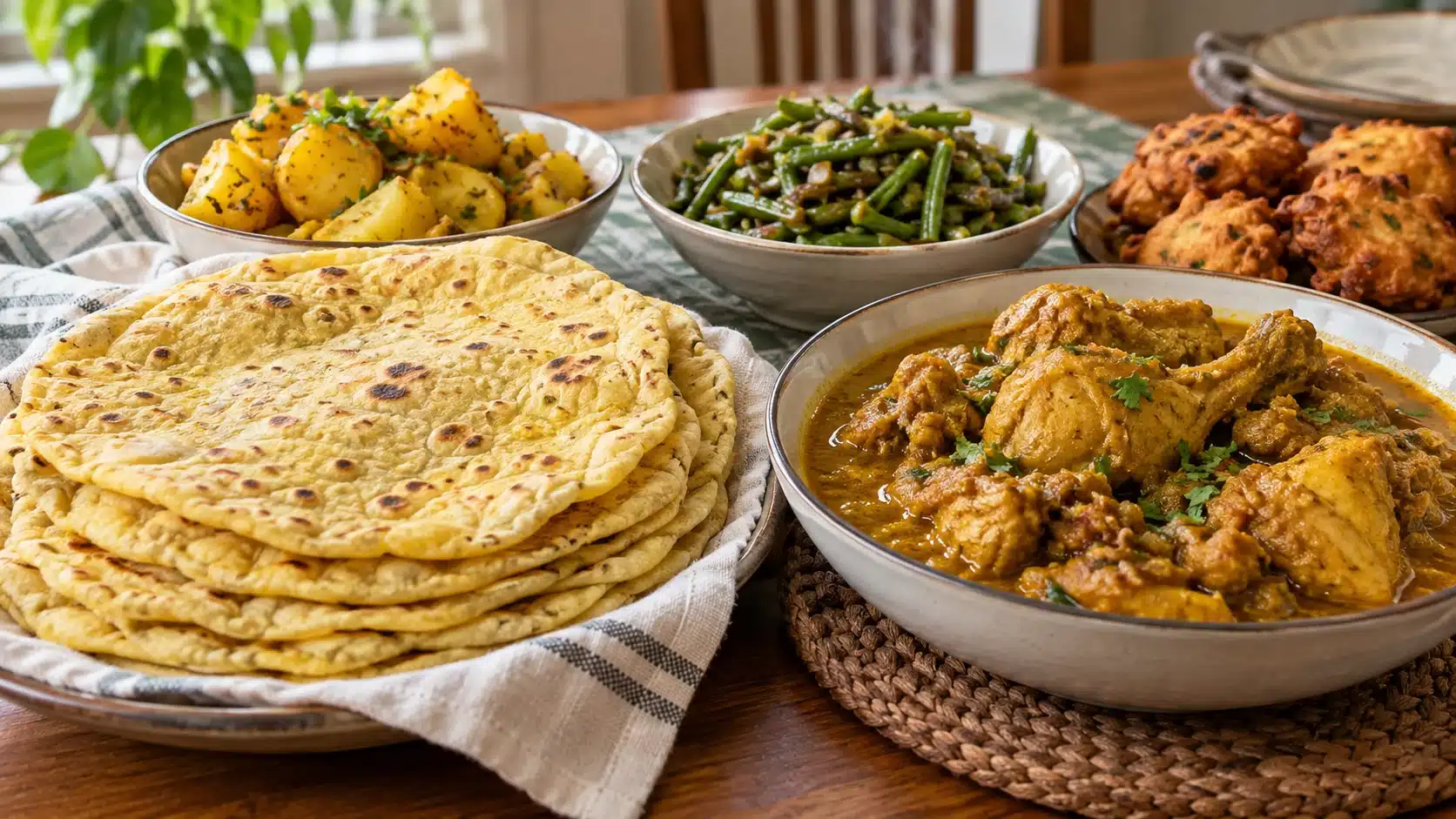
Its best-known dishes are dhal puri roti filled with ground split peas, roti kip, and bara made from urad dal batter, all seasoned with Surinaamse masala rather than Indian garam masala.
Most people in the Netherlands know roti as something you pick up from a Surinamese takeaway on a Friday evening.
Fewer know where it comes from, or why it tastes so different from the roti at an Indian restaurant.
Surinaams-Hindustani food is not a variation on Indian food.
It is a living cuisine with its own rules, its own spice blends and its own family recipes, cooked in kitchens from Paramaribo to Amsterdam Zuidoost, Den Haag and Utrecht.
A short history, kept short
From 1873, after slavery was abolished in Suriname, the colonial authorities brought indentured labourers from British India to work on the plantations.
Most came from the Bhojpuri-speaking regions of what are now Uttar Pradesh and Bihar.
They carried their language, their faith and their cooking with them, and over generations that cooking adapted to a new country.
Wheat flour, split peas and spice blends stayed.
Local ingredients such as madame jeanette peppers, kouseband and cassava came in.
Javanese, Chinese and Creole neighbours added ketjap, sambal and new habits.
Around Suriname’s independence in 1975, a large part of the Hindustani community settled in the Netherlands.
Today the food is simply part of Dutch life, and the next generation is cooking it at home.
How Surinaams roti differs from Indian roti
In most of India, roti means a small, plain flatbread of wholewheat atta, eaten fresh off the tawa.
Surinaams roti is a different thing.
The best-known version, dhal puri roti, is large, thin and soft, made from plain wheat flour and filled with a fine, dry layer of cooked and ground yellow split peas seasoned with cumin and garlic.
It is rolled out with the filling inside, cooked on a flat iron plate, and brushed with oil or ghee.
The way it is eaten differs too.
In a Surinamese home the roti is folded and served beside the curry, and you tear off pieces to scoop up the chicken, potato, kouseband and sauce.
The wrapped “roti rol” sold at takeaways is a later convenience, not the traditional way.
Dhal puri is a skill that takes practice, mostly in keeping the split pea filling dry so it does not burst through the dough.
Most families make it for weekends and celebrations rather than every day.
For the filling and the dough you will need split peas and urad dal from the dal aisle, and a good plain wheat roti flour.
Surinaamse masala versus Indian garam masala
This is where many cooks go wrong.
Surinaamse masala and Indian garam masala share a name and a family resemblance, but they are used in opposite ways.
- Surinaamse masala is a cooking blend.
It is built on coriander and cumin, often with fenugreek and turmeric, and is milder in heat.
It goes in at the start, is fried in oil with garlic and onion, and becomes the body of the curry.
Roti kip without it does not taste like roti kip. - Indian garam masala is a finishing blend of warmer spices such as cinnamon, cloves and cardamom.
It is added in small amounts at the end and is not the base of the sauce.
So a recipe for Surinamese curry that says “masala” means several tablespoons of Surinaamse masala, not a pinch of garam masala.
Swap them and the dish will taste wrong in both directions.
We explain the Indian side of this in why garam masala is not curry powder.
Keep a dedicated jar of Surinaamse masala and salam leaves for Surinamese dishes and you will not mix them up.
Bara (makes about 12)
Bara are soft, savoury fritters made from urad dal, crisp outside and airy inside, eaten as a snack with chutney or a sour pickle.
They are the easiest place to start, because they need no special technique beyond patience with the batter.
Many Surinamese families make bara with urad flour, wheat flour and yeast.
This version uses soaked whole dal and needs no yeast.
- 200 g split white urad dal
- 2 cloves of garlic
- 1 teaspoon of ground roasted cumin
- Three-quarters of a teaspoon of salt
- A quarter teaspoon of baking powder
- Oil for deep frying
- Rinse the urad dal well and soak it in plenty of cold water for 4 to 6 hours.
- Drain thoroughly.
Grind it with the garlic and as little water as possible, a tablespoon or two at a time, until you have a thick, smooth paste.
Too much water and the bara will spread and turn oily. - Stir in the cumin and salt, cover, and leave the batter to rest for about an hour at room temperature.
- Just before frying, add the baking powder and beat the batter hard with a spoon or your hand for two or three minutes.
This traps air and makes the bara light.
A small blob dropped into a bowl of water should float. - Heat the oil to about 175 degrees Celsius.
Wet your hands, take a spoonful of batter, flatten it slightly on your fingers, poke a hole in the centre if you like the ring shape, and slide it into the oil. - Fry for 4 to 5 minutes, turning once, until deep golden.
Drain on paper and eat warm.
Serve with a sour chutney or a sambal.
Ready-made Surinaams chutneys and roti sambal save time, and many families keep one open in the fridge all year.
The building blocks of a Surinaams kitchen
A Surinaams-Hindustani pantry looks partly Indian and partly something else entirely.
These are the ingredients that come up again and again:
- Yellow split peas: the filling of dhal puri roti and the base of a thin Surinamese dal.
Not the same as chana dal, which is firmer. - Urad dal: for bara and phulauri.
- Madame jeanette: the fiery, fruity yellow or red pepper that defines Surinamese heat.
Use it whole in a curry for aroma and pierce it only if you want real heat. - Trassi: fermented shrimp paste from the Javanese-Surinamese kitchen, used in small amounts for depth in sambals and some vegetable dishes.
Not vegetarian. - Cassava (cassave): boiled or fried as a side, or grated into cakes.
- Kouseband: long yardlong beans, cooked into roti kip or stir-fried on their own.
- Amchur: dried mango powder, for sour chutneys and some vegetable dishes.
- Salam blad and ketjap: the Indonesian bay leaf and sweet soy sauce that crossed over from the Javanese community.
For the Indian side of the pantry, amchur and whole cumin are worth keeping alongside your masala.
Roasted ground cumin, called geroosterde jeera in many Surinamese recipes, is easy to make yourself by dry-roasting whole cumin and grinding it.
Roti kip, the dish everyone starts with
Roti kip is the dish most people mean when they say “roti”.
It is a chicken curry cooked with plenty of Surinaamse masala, garlic and onion, then simmered with potatoes, kouseband and often a hard-boiled egg, served beside dhal puri or plain roti.
The sauce is looser than many Indian curries, because it is meant to soak into the bread.
The method is straightforward once the masala is right.
Marinate the chicken with masala, garlic and salt.
Fry more masala in oil until it darkens and smells toasty, which takes a few minutes and is the step that gives the dish its character.
Add the chicken and brown it, then the potatoes, water and a whole madame jeanette for aroma.
Simmer until the potatoes are soft, add the kouseband for the last ten minutes, and finish with the boiled eggs.
Vegetarian households make the same dish with potatoes, kouseband and chickpeas, or with eggs alone.
If you want a lighter dal to serve with it, a thin Surinamese dal of yellow split peas and cumin is traditional, and our guide to dals covers the cooking.
See our guide to dals for timings.
Where to buy the specifics
We stock the Surinaams-Hindustani essentials alongside the Indian and Pakistani ranges: split peas, urad dal, flour, Surinaamse masala, Surinamese chutneys and sambals, and the Indonesian staples that sit beside them.
Stock of fresh peppers and some imported items varies, so check the shop before planning a big cook around them.
We deliver same-day across Nieuwegein, Utrecht, Leidsche Rijn, Vleuten, Maarssen, Zeist, Bunnik, IJsselstein, Vianen and Culemborg.
Delivery is a flat 2.49 euros and free on orders over 49 euros.
Two practical questions
Can I use chana dal instead of yellow split peas for dhal puri?
It is possible, but the filling will be heavier and harder to grind to the fine, dry powder that dhal puri needs, and the flavour is nuttier than the traditional version.
Yellow split peas are cheaper and easier, so use them if you can.
Is Surinaamse masala the same as Indian curry powder?
They are closer to each other than either is to garam masala, because both are cooking blends with turmeric, coriander and cumin.
The balance differs, though, and Surinamese recipes are written for Surinaamse masala, so use that for roti kip and Surinamese curries.
Start with bara, work up to dhal puri, and the rest of the Surinaams kitchen will follow.


You must be logged in to post a comment.