
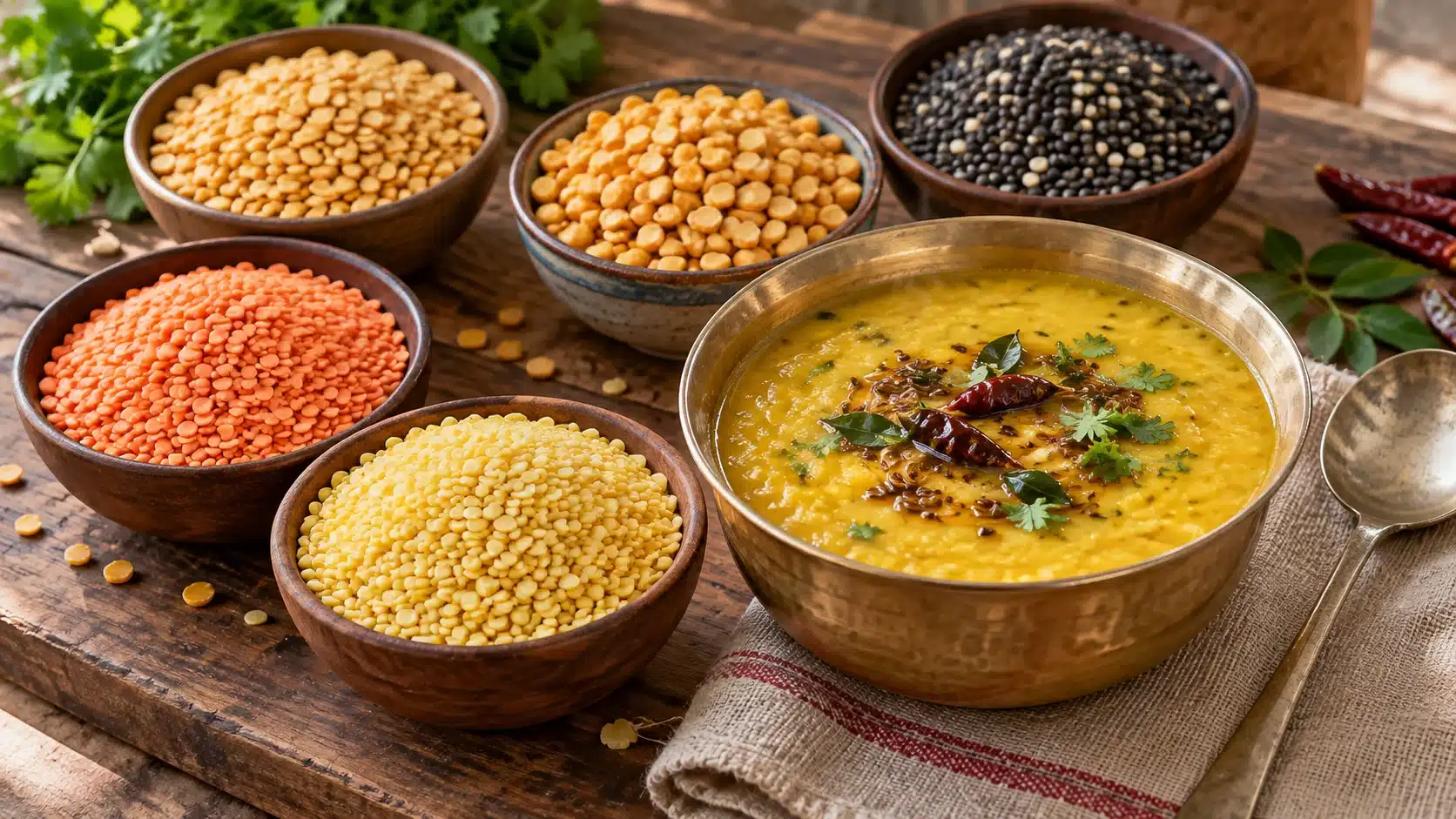
The Complete Guide to Indian Lentils and Dals
In short: Most Indian dals come from five pulses: toor (pigeon pea), moong (mung bean), masoor (red lentil), chana (split chickpea) and urad (black gram).
Masoor and moong cook fastest with no soaking, toor needs a short soak, and chana and urad need several hours.
Dal tastes right when you salt it properly and add the tadka last.
Walk down a dal aisle and you will count a dozen names or more: arhar, tuvar, chilka, dhuli, sabut, malka, kali.
It looks like a dozen different products.
In reality it is the same five pulses sold whole, split, with their skins or without.
Once you can read the names, choosing the right dal for a dish takes seconds, and cooking it well comes down to a few habits.
How Indian lentils are named
Three words do most of the work on a dal packet:
- Sabut means whole, with the skin on.
Slowest to cook, holds its shape, earthy flavour. - Chilka means split but with the skin still on.
Medium cooking time, slightly earthy, a little texture. - Dhuli means split and washed, with the skin removed.
Fastest to cook, softest and creamiest.
Urad is the clearest example of all three.
Whole urad (sabut urad) is small and black, and it is the bean in dal makhani.
Split urad with its skin (urad chilka) is black and white, used in Punjabi home dals.
Split skinned urad (urad dhuli) is creamy white, and it is what you soak and grind for dosa and idli batter.
Same bean, three products, three different dishes.
The same logic applies to moong.
Whole green moong is the sprouting bean, split moong chilka is green and yellow, and dhuli moong is the small yellow dal used for khichdi.
When a recipe just says “moong dal”, it almost always means the yellow dhuli kind.
The five you will actually use
Toor dal / arhar dal (split pigeon peas)
The everyday yellow dal of much of India, and the base of Gujarati dal and South Indian sambar.
It has a mild, slightly sweet flavour and cooks to a smooth, pourable consistency.
Rinse well and soak for 30 minutes, then it takes about 25 to 30 minutes in a pan.
Some toor dal is sold oily, coated in a little oil to keep it longer.
Rinse that kind in warm water until the water runs clear.
Moong dal (split yellow mung beans)
The lightest and gentlest dal, and the one used for khichdi, the rice and dal dish many families make on quiet evenings.
No soaking needed.
It softens in about 20 to 25 minutes and has a clean, delicate taste that suits a simple cumin tadka.
Dry-roasting the dal in the pan for a few minutes before adding water gives it a lovely nutty note.
Masoor dal (split red lentils)
The fastest of all.
These small orange-pink lentils need no soak and collapse into a soft puree in 15 to 20 minutes, turning yellow as they cook.
Masoor is the dal for a weeknight when you have half an hour.
It is also the lentil most Dutch supermarkets already sell as “rode linzen”, so it is a familiar place to start.
Chana dal (split Bengal gram)
Split, skinned desi chickpeas.
Nutty, slightly sweet and firm, chana dal holds its shape even when fully cooked, which makes it ideal for dry dishes, for mixing with vegetables such as lauki (bottle gourd), and for festive dals.
Soak it for at least an hour, longer if you can, then cook for 45 to 60 minutes in a pan.
Do not confuse it with yellow split peas.
They look similar, but chana dal is firmer and nuttier.
Urad dal (black gram)
Rich, heavy and creamy, with a texture that turns almost silky after long cooking.
Whole black urad is the heart of dal makhani: soak it overnight, then simmer it for well over an hour with butter and cream.
Split white urad is soaked for four to six hours and ground for dosa, idli and vada batter.
Urad is the dal people mean when they talk about a “rich” restaurant dal.
A comparison at a glance
| Dal | English name | Soak needed | Pan cooking time | Texture | Classic dish |
|---|---|---|---|---|---|
| Toor / arhar | Split pigeon peas | 30 minutes (helps) | 25 to 30 min | Smooth, pourable | Sambar, Gujarati dal, dal tadka |
| Moong (dhuli) | Split yellow mung beans | None | 20 to 25 min | Soft, light | Khichdi, moong dal tadka |
| Masoor | Split red lentils | None | 15 to 20 min | Melts to a puree | Masoor dal, everyday weeknight dal |
| Chana dal | Split Bengal gram | 1 to 2 hours | 45 to 60 min | Firm, holds shape | Chana dal with lauki, dal fry |
| Urad (sabut) | Whole black gram | Overnight | 90 minutes or more | Creamy, heavy | Dal makhani |
| Urad (dhuli) | Split white gram | 4 to 6 hours | Ground raw for batter | Light, fluffy when fermented | Dosa, idli, vada |
Times are for soaked or rinsed dal in an ordinary pan over a gentle simmer.
Older dal takes longer, so treat these as a guide and taste rather than trusting the clock.
All five are on our shelves, and you can see the full range of dals and lentils in one place, including whole, chilka and dhuli versions.
Everyday tadka dal (serves 4)
This is the dal that teaches you everything else.
The secret is the order: cook the dal plain and soft first, make the tadka separately, and pour the tadka over at the very end.
Spices fried into the pot at the start lose their sizzle.
Spices poured over at the end stay bright.
For the dal
- 200 g toor dal, or half toor and half masoor
- 900 ml water
- Half a teaspoon of turmeric
- 1 teaspoon of salt, then more to taste
For the tadka
- 2 tablespoons of ghee
- 1 teaspoon of cumin seed
- A pinch of hing
- 2 dried red chillies
- 3 cloves of garlic, thinly sliced
- 1 small tomato, finely chopped
- Juice of half a lemon and a handful of fresh coriander to finish
- Rinse the dal three or four times until the water is no longer cloudy, then soak it for 30 minutes and drain.
- Put the dal, water and turmeric in a heavy pan.
Bring it to the boil, skim off the foam, then cover partly and simmer for 25 to 30 minutes, stirring now and then, until the grains are completely soft. - Whisk the dal or mash it with the back of a spoon until smooth.
Add the salt.
It should be loose enough to pour.
Add hot water if it is too thick. - In a small pan, heat the ghee until a cumin seed sizzles.
Add the cumin, then the hing and red chillies, then the garlic.
Fry until the garlic is just golden, about a minute. - Add the tomato and cook for two or three minutes until it softens.
- Pour the sizzling tadka over the dal, stir once, then squeeze in the lemon and scatter over the coriander.
Every spice in this tadka, cumin, hing and mustard seed included, sits in a basic rack.
If you are building one, start with a starter spice rack.
Use real ghee for the tadka if you can, because its nutty flavour is half the point.
Serve with plain basmati or jeera rice, and pick your rice to serve alongside while you are ordering the dal.
Pressure cooker, pan or Instant Pot
Each method works.
They differ in speed and in how much attention they need.
- Pan: the times in the table above.
Slowest, but you can watch and adjust, and it needs no special kit.
Keep the lid partly on and top up with hot water. - Stovetop pressure cooker: the Indian household standard.
Masoor and moong need about 2 whistles, toor about 3 to 4, soaked chana dal about 4 to 5, and soaked whole urad about 20 to 25 minutes on low after the first whistle.
Let the pressure drop on its own before opening.
If you cook dal more than once a week, a pressure cooker pays for itself in time saved. - Instant Pot or electric pressure cooker: on high pressure, about 5 minutes for masoor, 6 to 8 for moong, 10 to 12 for toor, 12 to 15 for soaked chana dal and 30 to 35 for soaked whole urad, each followed by 10 minutes of natural release.
Whichever you use, never fill a pressure cooker more than half full with dal and water.
Dal foams, and the foam can block the valve.
Why your dal tastes flat
If your dal is edible but forgettable, it is almost always one of four things.
- Not enough salt. Dal needs more salt than people expect, often a full teaspoon or more for four servings.
Taste after salting, wait a minute, taste again. - No acid. A squeeze of lemon, a spoon of tamarind or a cooked-down tomato wakes the whole pot up.
Dal without acid tastes heavy and dull. - Tadka made too early. If the spices went in at the start and simmered for half an hour, their aroma is gone.
Fry them separately and pour them over at the end, as in the recipe above. - Not enough fat. A tadka made with half a teaspoon of oil cannot carry the flavour of the spices.
Two tablespoons for a pot of four servings is normal.
Fix those four and a plain dal becomes the dish you crave on a cold evening.
Buying and storing
Buy dal in amounts you will use within six months to a year.
Old dal is safe to eat but takes much longer to soften, and some very old dal never fully softens at all, which is often the real reason a recipe “did not work”.
Keep it in airtight jars in a cool, dark cupboard, away from moisture.
Rinse every dal before cooking.
Pick through whole dals such as urad and chana for the odd small stone, which can happen with any pulse.
Two related reads: yellow split peas, not chana dal, fill the Surinaams dhal puri roti, and if you want to cook with whole grains as well as pulses, the Indian millets guide pairs well with this one.
New to all of it?
Begin with a first week of Indian cooking.
When you are ready to stock up, browse the whole aisle and pick up two or three dals at once, so you can rotate them through the week.
We deliver same-day across Nieuwegein, Utrecht, Leidsche Rijn, Vleuten, Maarssen, Zeist, Bunnik, IJsselstein, Vianen and Culemborg.
Delivery is a flat 2.49 euros and free on orders over 49 euros.
Two practical questions
Can I swap masoor dal for toor dal in a recipe?
Yes, but shorten the cooking time to about 15 to 20 minutes and skip the soak, or the masoor will turn to mush before the rest of the dish is ready.
The flavour will be a little earthier and the texture thicker.
Why are my chana dal or whole urad still hard after an hour?
Usually because the dal is old, or because salt, tomato or tamarind went in before it softened, which can stop it softening fully.
Soak it longer, cook it in plain water until tender, and add salt and acid only at the end.
Pick one dal, cook it three times this month, and the rest of the aisle will make sense.




You must be logged in to post a comment.