
How to Build an Indian Spice Rack from Scratch
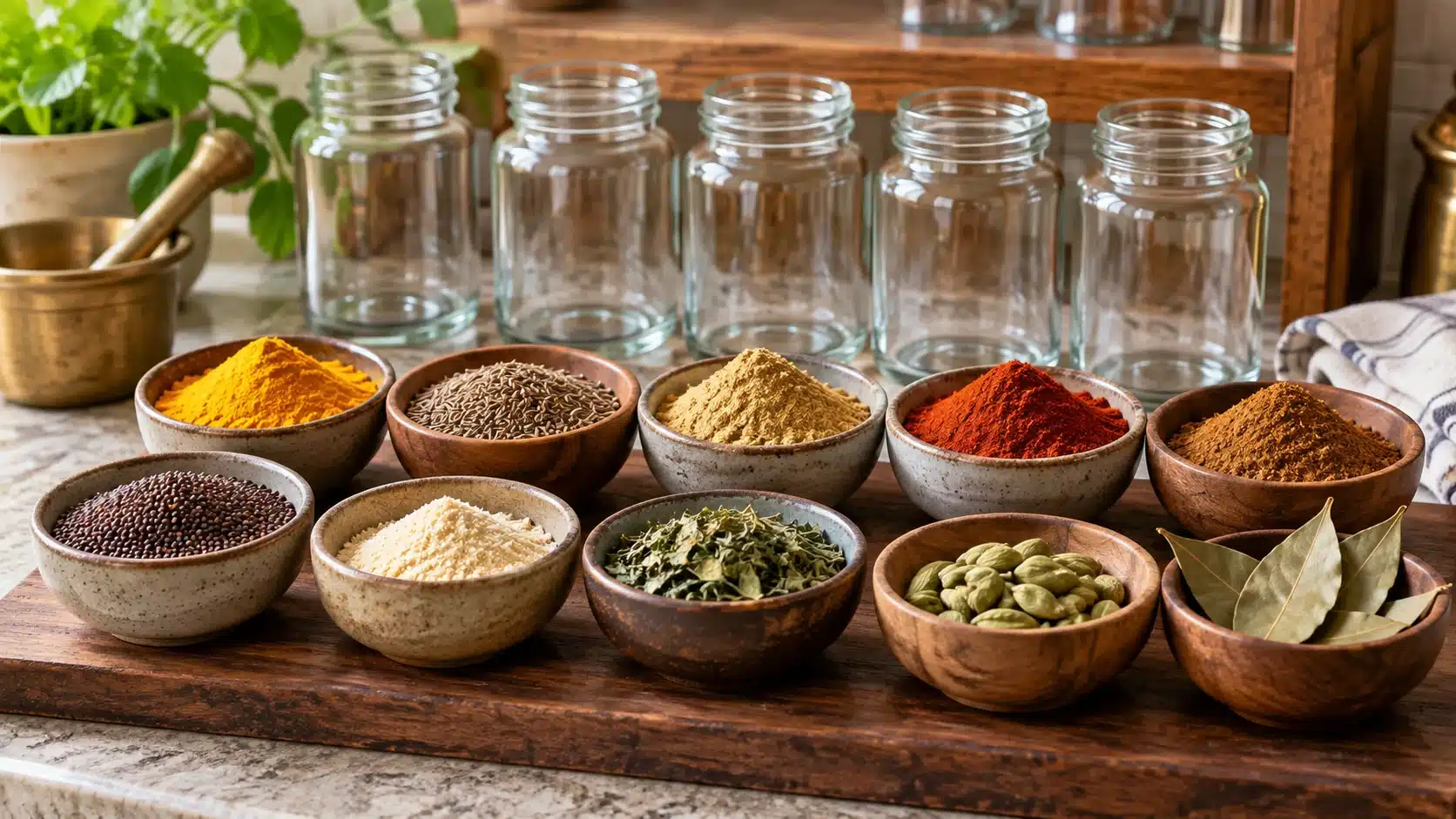
In short: An Indian spice rack needs ten spices to start: turmeric, cumin seed, coriander powder, red chilli powder, garam masala, mustard seed, hing (asafoetida), kasoori methi, green cardamom and bay leaf.
Buy small packs, keep them airtight and away from heat, and replace ground spices about once a year.
The most common mistake is buying thirty jars on the first trip.
Half of them go stale before they are opened, the rack becomes a museum, and cooking starts to feel like a test.
A short list you actually use beats a long one you are afraid of.
Learn what a handful of spices do, and almost every everyday Indian dish opens up.
The first ten, and what each actually does
Each of these earns its place by turning up in dish after dish.
Buy them in small packs of 50 to 100 g until you know how fast you get through them.
1. Turmeric (haldi)
A bright yellow ground root with an earthy, slightly bitter taste.
It gives dal, sabzi and curry their warm colour and a background depth you notice when it is missing.
Use it sparingly, about half a teaspoon for a pot of dal, and add it with the onions or the liquid so it cooks through.
Raw turmeric tastes dusty.
2. Cumin seed (jeera)
The most-used whole spice in North Indian cooking.
Fried in hot oil, it turns nutty and fragrant in seconds.
It goes first into dal, jeera rice and most dry vegetable dishes.
If you buy only one whole spice, buy this.
3. Coriander powder (dhania)
Ground coriander seed, mild, citrusy and slightly sweet.
It is the bulk of most curry bases and the spice that makes a masala taste rounded rather than sharp.
You will use more of it than anything else, so it is worth buying a larger pack once you are cooking regularly.
4. Red chilli powder (lal mirch)
This is where the heat comes from.
Indian chilli powder is usually hotter than paprika and is not the same as the “chili powder” blend sold in Dutch supermarkets, which contains cumin and oregano.
Start with a quarter teaspoon and work up.
5. Garam masala
A finishing blend of warm spices such as cinnamon, cloves, cardamom and black pepper.
It goes in at the end of cooking, not the start, because its aroma fades with long heat.
A pinch stirred into a finished curry lifts the whole pot.
More on why it is not curry powder below.
6. Mustard seed (rai)
Small black or brown seeds that pop and crackle in hot oil and give a sharp, nutty bite.
They are central to South Indian and Gujarati cooking: sambar, lemon rice, potato bhaji, coconut chutney.
When they stop popping, the oil is ready for the next step.
7. Hing (asafoetida)
A resin sold as a yellowish powder.
In the jar it smells pungent, almost sulphurous, but a pinch in hot oil turns into a savoury, onion-and-garlic flavour.
Many kitchens that cook without onion and garlic rely on it.
Keep the lid tight, because the smell travels into everything else.
8. Kasoori methi
Dried fenugreek leaves with a savoury, slightly bitter, almost maple-like aroma.
Crush a teaspoon between your palms over a finished butter chicken, paneer makhani or dal makhani and it suddenly tastes like the restaurant version.
It is the cheapest upgrade on this list.
9. Green cardamom (elaichi)
Small green pods with a floral, sweet, eucalyptus-like fragrance.
Lightly crushed whole pods go into pulao and a proper layered biryani, the seeds go into chai and almost every Indian sweet.
Buy whole pods.
Ground cardamom loses its scent within weeks.
10. Bay leaf (tej patta)
Indian bay leaves are larger and more cinnamon-scented than the European bay leaves in Dutch kitchens, though either will do at first.
One or two go into hot oil at the start of rice dishes, rajma and chole to give a gentle, warm background note.
Remove them before serving.
That is the whole starter set.
You can buy whole and ground spices in small sizes, which is the cheapest way to build the habit without waste.
Whole versus ground, and why it matters
Whole spices and ground spices do different jobs, so you will usually want both forms of the most important ones.
- Whole spices are for tempering. Cumin, mustard seed, cardamom, cloves and bay leaf release their flavour into hot fat at the start of cooking and stay in the dish as little bursts of flavour.
- Ground spices are for body. Turmeric, coriander and chilli powder dissolve into the onion and tomato base and become the sauce itself.
- Whole spices keep far longer. A sealed bag of whole cumin is still lively after a year.
Ground cumin goes flat in a few months, because grinding exposes the oils to air.
If you get serious, buy whole cumin and coriander and grind small amounts in a spice or coffee grinder kept only for spices.
The difference in a simple dal is obvious.
Tadka, the technique that uses half the rack
Tadka, also called tempering or chhonk, is the single technique that makes this rack make sense.
You heat a spoon or two of fat, add whole spices, let them sizzle for seconds, then pour the lot over a dish or build the dish on top of it.
- Heat the fat until a single cumin seed dropped in sizzles immediately.
- Add whole seeds first: mustard, then cumin.
Listen for the pop and crackle.
That takes about 30 seconds, not minutes. - Add the faster-burning things next: a pinch of hing, dried red chillies, curry leaves.
A few seconds is enough. - Pour it over the dal or carry on with onions.
Do not walk away, because burnt cumin tastes bitter and cannot be rescued.
The fat matters as much as the spices.
Ghee gives a rich, nutty finish, mustard oil a sharp one and a neutral oil lets the spices speak alone, so keep the oil or ghee you temper in next to the hob.
For more on which fat suits which dish, see our guide to which fat suits which dish, and for tadka in action, start with the everyday dal in our guide to Indian lentils.
The next ten, once you are cooking weekly
When the first ten are running low regularly, you are ready for these.
Add them one or two at a time, as recipes ask for them.
- Ajwain (carom seed): thyme-like and strong, used in parathas, pakoras and puris.
A little goes a long way. - Fennel seed (saunf): sweet and anise-like, for Kashmiri dishes, pickles and the after-meal mouth freshener.
- Black cardamom (badi elaichi): large, smoky pods for biryani, rajma and slow-cooked meat dishes.
Not interchangeable with green. - Cloves (laung): intense and warming, for rice dishes and garam masala.
- Cinnamon or cassia (dalchini): the bark sticks used in pulao, biryani and curries.
- Amchur (dried mango powder): sour and fruity, for dry dishes where lemon juice would make things soggy.
- Chaat masala: a tangy, salty, funky blend for fruit, snacks, raita and the dishes in our guide to Indian street-food snacks.
- Kashmiri chilli: deep red colour with mild heat, so you can make a dish look rich without making it fierce.
- Nigella seed (kalonji): small black seeds with an onion-like flavour, for naan, pickles and Bengali cooking.
- Curry leaves: the signature aroma of South Indian tadka.
Fresh is best, dried works in a pinch.
Storing spices so they last
Spices do not go off in a dangerous way, they simply fade.
Four habits keep them tasting of something:
- Airtight: tip open packets into jars with tight lids, or use a stainless steel masala dabba, the round tin with seven small bowls inside.
- Dark: keep them in a cupboard or drawer, not on an open shelf in the sun.
- Cool: never on the shelf above the hob, however convenient.
Heat and steam are what kill flavour fastest. - Small and fresh: buy in small packs and replace ground spices roughly once a year.
If a ground spice has no smell when you rub a pinch between your fingers, it has no flavour left either.
Garam masala is not curry powder
This is the single most useful correction for anyone who learned to cook in a Dutch or British kitchen.
The yellow “curry powder” sold in most supermarkets is a European invention, a general all-in-one blend heavy on turmeric, coriander and fenugreek, designed to make “curry” in one step.
Indian home kitchens do not really use it.
Garam masala is a different thing with a different job.
It contains no turmeric, it is not the base of the dish, and it is not cooked for long.
It is a fragrant finishing blend, added at the end in small amounts.
If you swap one for the other, the dish either turns yellow and muddy or loses its top note.
The Indian way is to build the base from separate spices, turmeric, coriander, cumin and chilli, and then finish with garam masala.
That is why the starter rack above has five spices instead of one jar.
Once you know that, a recipe that lists six spices stops looking like a shopping problem.
There is a middle ground.
Dish-specific blends, chana masala, rajma masala, sambar powder, biryani masala, are genuine Indian kitchen staples and a perfectly good shortcut on a weeknight.
The ready-made blends from MDH and Everest are what many Indian households keep for exactly that.
Surinaamse masala is its own blend again, with a different balance, which we explain in our guide to Surinaams-Hindustani cooking.
Where to buy
Every spice on both lists is on our shelves, in small packs for a first rack and in larger bags once you know what you use.
You can find everything on one shelf, which makes a starter order quick.
Green cardamom also goes straight into proper masala chai, and if you want a full first-week plan, read Indian cooking for beginners next.
We deliver same-day across Nieuwegein, Utrecht, Leidsche Rijn, Vleuten, Maarssen, Zeist, Bunnik, IJsselstein, Vianen and Culemborg.
Delivery is a flat 2.49 euros and free on orders over 49 euros.
Two practical questions
Can I use cumin powder when a recipe says cumin seed?
Not in a tadka.
Powder burns in hot oil within seconds and turns bitter.
Use about half the quantity of powder and add it with the onions or the liquid instead, and expect a softer, less nutty result.
Is Indian bay leaf the same as the bay leaf in a Dutch supermarket?
No.
The Indian tej patta comes from a different tree and tastes more of cinnamon and clove, while European laurel bay is more herbal.
European bay works in a pinch, but use it lightly, because its flavour is sharper.
Start with ten, cook with them often, and the rest of the rack will build itself.


You must be logged in to post a comment.