
Your Diwali Shopping List: Sweets, Puja Items and Gifts
In short: A Diwali shopping list works best as a timeline.
Diwali falls on Sunday 8 November 2026, so buy dry fruit, jaggery and gifts four weeks ahead, diyas, wicks and puja items two weeks ahead, and fresh sweets and namkeen in the final week.
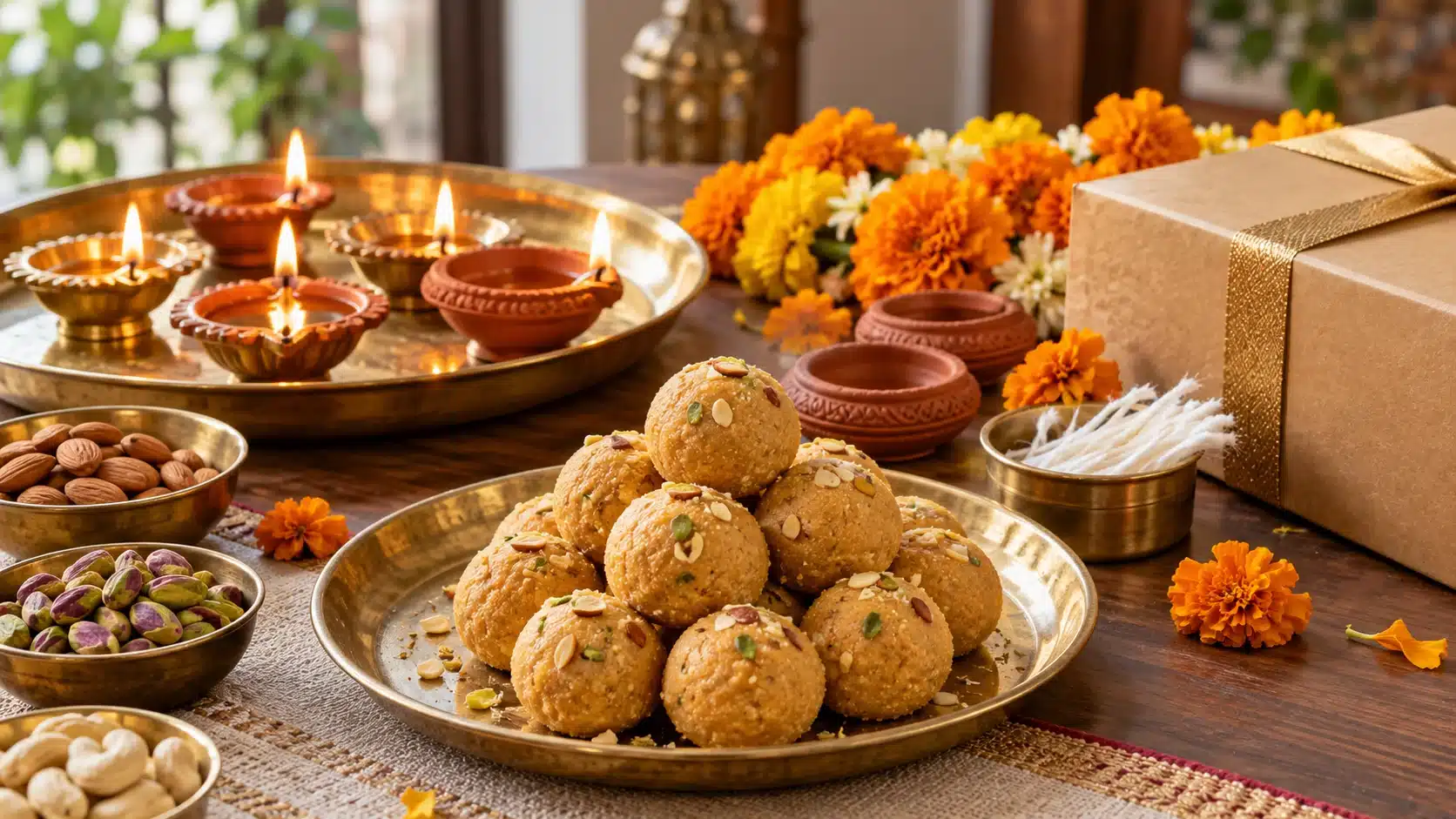
Besan ladoo is the easiest homemade sweet to start with.
Celebrating Diwali away from India changes the planning.
There is no market lane outside your door selling diyas and fresh barfi, and the things you forget on the day are the things you cannot easily pick up at a Dutch supermarket.
The good news is that almost everything keeps, so a little order in the weeks before takes the pressure off the week itself.
If your household is also keeping Navratri this autumn, our Navratri fasting food guide covers that pantry, and much of it carries straight on into Diwali cooking.
Below is one list, ordered by when you actually need each thing.
Four weeks out: gifts and dry goods
Start with whatever keeps longest and whatever you may need to post.
Dry fruit is the classic Diwali gift for a reason: almonds, cashews, pistachios and raisins travel well, last for months in a sealed tin and look generous in a simple box.
Jaggery and dried coconut belong in the same early order, because they go into so many festival sweets and you do not want to run out halfway through a batch.
This is also the moment to buy any tinned or boxed sweets you plan to give away.
Tinned rasgulla, gulab jamun and soan papdi have a long shelf life and are easy to share with neighbours and colleagues who are new to the festival.
Pick up your dry fruit, jaggery and mithai ingredients in one go now and that whole category is settled.
- Almonds, cashews, pistachios and raisins, for gifting and for sweets
- Jaggery and desiccated or dried coconut
- Saffron and green cardamom, which are small, expensive and easy to forget
- Tinned or boxed sweets to give away
Two weeks out: the puja shelf
Lakshmi Puja is the heart of the evening, and most of what it needs is small and fiddly to source.
Diyas come first.
Plain clay diyas are the traditional choice and many families buy a fresh set each year, while painted and decorated ones are kept for the doorway and the rangoli.
We carry diyas in every size and finish, from small raw clay sets to akhand diyas meant to burn through the night.
Then the smaller things.
Cotton wicks, a bottle of lamp oil or ghee for the diyas, incense sticks, camphor, roli and kumkum for the tilak, supari, and a fresh cloth for the altar.
These are cheap individually and impossible to replace at eight in the evening on Diwali itself, so check them off together.
You will find the incense, camphor and puja essentials in one place.
Decoration is worth thinking about now too, before the week gets busy.
A toran over the front door and a few marigold strings change how the whole house feels.
Our torans and marigold garlands are reusable, so this is often a one-time purchase.
- Clay diyas, plus one long-burning akhand diya if your family keeps one lit
- Cotton wicks and lamp oil or ghee
- Incense, camphor, roli, kumkum and supari
- A toran and marigold decorations
The week itself: sweets and snacks
Fresh sweets are the part everyone looks forward to, and the part that needs the most honest planning.
Decide early which sweets you will make and which you will buy.
Most families make one or two things they are proud of and buy in the rest, and there is no shame in that.
Barfi, rasmalai and halwa from the ready-made mithai shelf fill the plate while you spend your own time on the one sweet that matters to your family.
If you only make one thing, make besan ladoo.
It needs four ingredients, no special equipment and no syrup-making, and it keeps for a week in a tin.
Besan ladoo (makes about 15)
The whole recipe is in the roasting.
Rushed besan tastes raw and pasty however much sugar you add.
Roasted slowly, it turns golden and smells like toasted nuts, and that is the flavour people remember.
- 200 g besan (gram flour)
- 100 g ghee
- 150 g powdered sugar
- Half a teaspoon of ground green cardamom
- 2 tablespoons of chopped almonds or pistachios (optional)
- Melt the ghee in a heavy pan over low heat.
Add the besan and stir until it is fully coated.
It will look like wet sand. - Keep the heat low and stir constantly for 15 to 20 minutes.
Do not turn the heat up to save time, because besan catches and burns at the base before the top is cooked. - Stop when the colour has deepened to golden, it smells nutty, and the mixture loosens and becomes almost runny as the ghee releases.
That loosening is the sign it is done. - Take it off the heat, stir in the cardamom and nuts, and let it cool until just warm.
If it is hot, the sugar melts and the ladoos will not hold. - Mix in the powdered sugar, then press handfuls of about 30 g into tight balls.
If the mixture will not bind, add a teaspoon of melted ghee and try again.
Use fresh besan for the ladoo rather than an old open bag, because stale gram flour tastes bitter after roasting.
Good ghee matters just as much here, so if yours is running low, add a tin of ghee to the same order, since you will want it for the diyas and the puja as well.
Namkeen and the savoury half
Almost every household over-buys sweets and under-buys savoury.
By the second evening of visitors, people are reaching past the barfi for something salty.
Plan roughly one savoury plate for every two sweet ones.
Mixtures, sev, mathri, chakli and roasted nuts all keep well in sealed tins and need no preparation, so they are the easiest part of the table to get right.
Stock up on namkeen and savoury mixes in the same week as the fresh sweets.
For children, and for adults who grew up with them, the old-fashioned candies, imli sweets and mukhwas from the retro sweet counter are a small thing that guests always notice.
A bowl of mukhwas by the door after dinner is a nice touch.
A note on gifting in the Netherlands
If you are sending gifts to family or friends in other cities, post them early.
Dry fruit boxes and tinned sweets travel well, but parcel services get busy in the weeks before the holidays and a box that arrives after Diwali loses most of its meaning.
For colleagues and neighbours who do not know the festival, a small box of mithai with a line explaining what Diwali is goes a long way, and it is one of the nicest ways to share it.
Keep fresh barfi and milk sweets for people you will see in person.
They do not survive the post.
Order it in one go
The simplest approach is two orders: one now for the dry goods, gifts and puja shelf, and one in festival week for fresh sweets and snacks.
Be aware that the shop gets busy in the week before Diwali and same-day delivery slots fill quickly, so the earlier your second order goes in, the better.
If you are new to cooking the festival meal itself, our guide to building a basic spice rack covers the spices you will reach for most.
We deliver same-day across Nieuwegein, Utrecht, Leidsche Rijn, Vleuten, Maarssen, Zeist, Bunnik, IJsselstein, Vianen and Culemborg.
Delivery is a flat 2.49 euros and free on orders over 49 euros, which a Diwali order usually clears without trying.
Two practical questions
Can I use ghee instead of oil in clay diyas?
Yes, and many families prefer it for the puja diya.
Ghee burns with a steady flame and little smoke, but it costs more, so a common habit is ghee for the main puja diya and lamp oil for the rows along the windows and doorway.
How far ahead can I make besan ladoo?
Up to about a week, stored in an airtight tin at room temperature.
Make them no more than a few days ahead if your kitchen is warm, and keep them away from the hob, where the ghee can soften and the ladoos lose their shape.
Wishing you a bright and peaceful Diwali, from all of us at Panjab Supermarket.


You must be logged in to post a comment.