
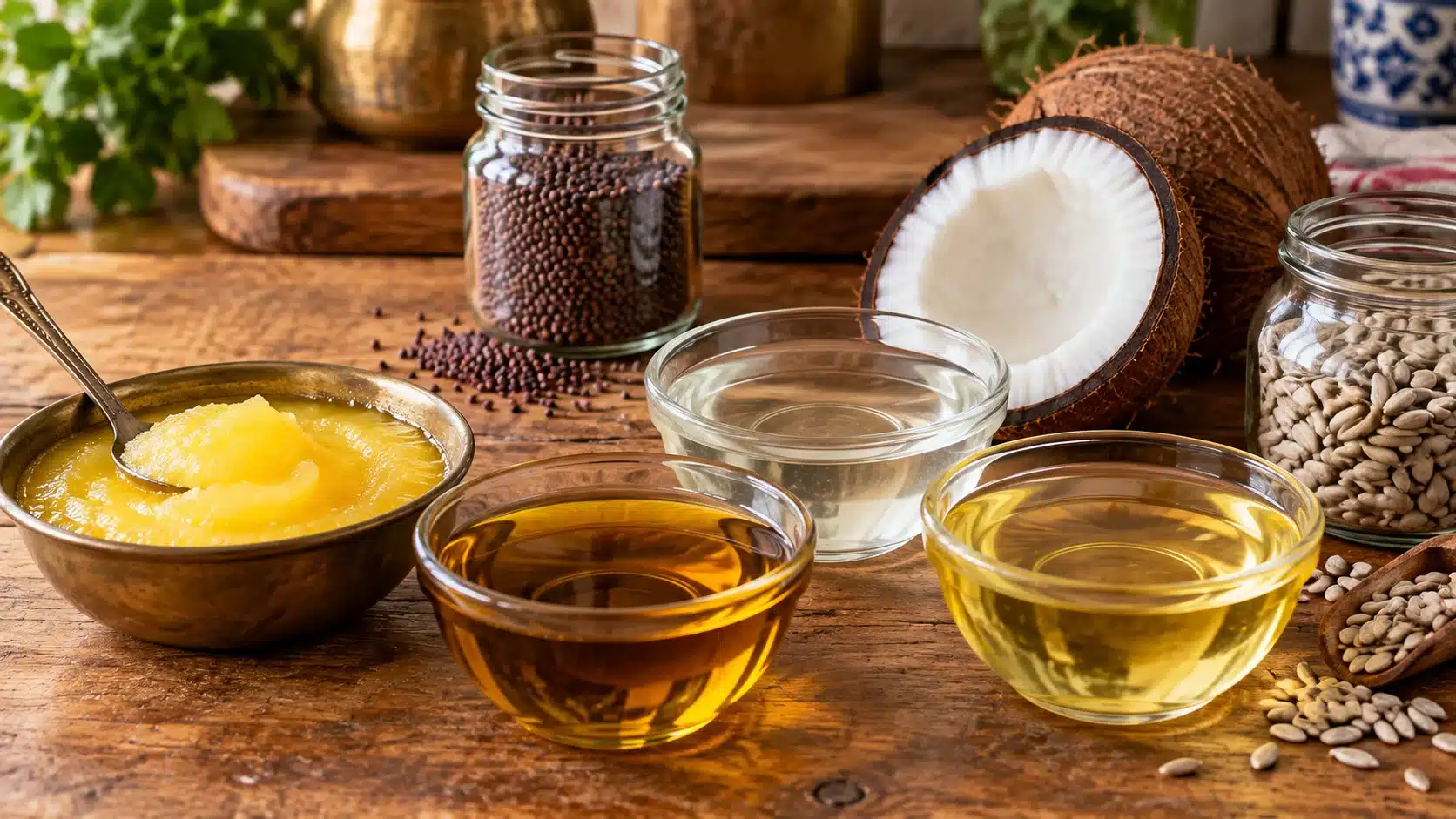
Ghee, Mustard Oil or Sunflower: Which to Cook With
In short: Indian cooking uses four main fats, each with its own flavour: ghee, mustard oil, coconut oil and sunflower oil.
Ghee is nutty and suits tadka, rice and sweets; mustard oil is sharp and suits curries and pickles.
Coconut oil belongs to Kerala and coastal cooking, while neutral sunflower oil lets the spices lead.
In much of European cooking, oil is a background ingredient: something to stop food sticking.
In Indian cooking, fat is a flavour in its own right.
A dal finished in ghee, the same dal tempered in mustard oil and the same dal made with sunflower oil are three noticeably different dishes.
Choosing the fat is part of choosing the dish.
Ghee
Ghee is clarified butter.
Butter is simmered gently until the water evaporates and the milk solids sink and turn golden, and the clear fat is strained off.
That slow browning is what gives ghee its nutty, slightly caramel flavour, quite different from ordinary melted butter.
Because the milk solids are removed, ghee has a high smoke point, around 250 degrees Celsius, so it can take the high heat of a tadka without burning the way butter does.
It is the classic fat for:
- Tadka poured over dal, where its aroma is the finishing touch
- Rice dishes, from jeera rice to the layer on top of a biryani
- Indian sweets such as halwa, ladoo and barfi, where it is essential
- Brushing rotis and parathas
- Puja diyas in many households
You do not need to cook everything in ghee.
Many families use a neutral oil for the bulk of the cooking and a spoon of ghee at the end, where its flavour shows most.
You can see that in an everyday tadka dal and on top of a dum biryani.
Mustard oil
Mustard oil is pressed from mustard seeds and is the default cooking fat across Punjab, Bengal, Bihar and much of North and East India.
Raw, it is sharp, pungent and almost wasabi-like.
Heated, it changes completely.
The traditional method is to heat mustard oil until it just begins to smoke, then take it off the heat for a moment and let it cool slightly before adding spices.
The pungency mellows into a deep, savoury, slightly bitter warmth that is the signature of Punjabi sarson ka saag, Bengali fish curries and many Bihari dishes.
Skip the heating step and the raw sharpness stays in the food.
Mustard oil is also the backbone of North Indian pickles.
Its sharpness balances the sour mango and lime, and it helps the spices cling.
If you have ever wondered where the bite in a Punjabi mango pickle comes from, it is the oil as much as the chilli.
Try a jar of pickles made with mustard oil and you will taste the difference straight away.
Coconut oil
Coconut oil is the cooking fat of Kerala and much of the southern and western coast.
It has a sweet, distinctly coconut aroma that suits fish and vegetable curries, avial, thoran and anything finished with curry leaves and mustard seed.
In those dishes it is not interchangeable: a Kerala curry cooked in sunflower oil tastes thin.
Virgin coconut oil has the strongest flavour and a lower smoke point, around 175 degrees Celsius, so it suits gentle cooking and tempering rather than deep frying.
Refined coconut oil is milder and handles higher heat.
Coconut oil turns solid below about 24 degrees, so in a Dutch kitchen it is usually white and firm for most of the year.
That is normal, and it melts as soon as it hits the pan.
Sunflower and other neutral oils
Sunflower, rapeseed and groundnut oil are the neutral options.
They have almost no flavour of their own and handle high heat well, so they are the right choice when you want the spices to do all the talking, and for deep frying pakoras, puris and samosas, where you need a lot of oil and a clean taste.
Many Gujarati and South Indian households cook day to day in groundnut or sunflower oil, keeping ghee for finishing.
A neutral oil is also the safest choice when you are learning, because it does not add a strong flavour you might not expect.
A quick matching table
| Dish | Best fat | Why |
|---|---|---|
| Dal tadka | Ghee | Nutty aroma poured over at the end |
| Punjabi saag, North Indian curries | Mustard oil | Heated first, gives depth and warmth |
| Achaar (mango, lime, chilli pickles) | Mustard oil | Sharpness balances the sourness |
| Kerala curries, thoran, avial | Coconut oil | Coconut aroma is part of the dish |
| Biryani, pulao, jeera rice | Ghee, or oil with ghee on top | Fragrance and separate grains |
| Halwa, ladoo, barfi | Ghee | Flavour and texture of the sweet |
| Pakoras, puris, samosas | Sunflower or groundnut | Clean taste, high heat, large volume |
| Everyday sabzi | Any, by region and taste | Mustard in the north, coconut on the coast, neutral anywhere |
Whatever the fat, it is only half of a tadka.
The other half is the spices you will be tempering, and the tadka method explains how the two work together.
Use a heavy kadhai or a thick-based pan, which holds heat steadily so spices sizzle instead of scorching.
Kachi ghani and cold-pressed: what the label means
You will see “kachi ghani” on many bottles of mustard oil.
It means the oil was pressed from the seeds at low temperature, traditionally in a wooden or stone press, rather than extracted with high heat.
The result keeps more of the mustard’s natural pungency and aroma, so kachi ghani mustard oil is stronger and more characterful than a refined one.
“Cold-pressed” means the same thing on other oils, such as coconut, groundnut and sesame.
Cold-pressed oils taste more of their source and usually have a lower smoke point than refined versions, so they suit tempering, dressings and gentle cooking better than deep frying.
Storing fats properly
- Dark, cool and sealed: light and heat make oils go rancid, so keep bottles in a cupboard, not on the windowsill or right beside the hob.
- Ghee keeps at room temperature: because the water and milk solids are removed, a sealed jar of ghee keeps for months in the cupboard.
Always use a clean, dry spoon, because water or crumbs are what spoil it. - Coconut oil goes solid: that is normal below about 24 degrees and does not mean it has gone off.
Scoop it out or warm the jar briefly in hot water. - Trust your nose: rancid oil smells stale, like old crayons or wet cardboard.
If it smells wrong, it will taste wrong.
Buying
Keep two fats as a minimum: a neutral oil for everyday cooking and frying, and a jar of ghee for finishing.
Add mustard oil when you start cooking Punjabi or Bengali dishes or making pickles, and coconut oil when you cook from the south.
We stock ghee, mustard oil and cooking oils in household and family sizes, including kachi ghani mustard oil.
We deliver same-day across Nieuwegein, Utrecht, Leidsche Rijn, Vleuten, Maarssen, Zeist, Bunnik, IJsselstein, Vianen and Culemborg.
Delivery is a flat 2.49 euros and free on orders over 49 euros.
Two practical questions
Can I use butter instead of ghee?
For finishing a dal or brushing a roti, unsalted butter works in a pinch.
For a tadka or any high-heat frying, no: the milk solids in butter burn quickly and turn bitter.
If you only have butter, melt it slowly and let it brown gently and you will have made a small batch of something close to ghee.
Why does my mustard oil taste harsh in curries?
It was almost certainly not heated enough first.
Heat it until it just starts to smoke, take the pan off the heat for about 30 seconds, then add your spices.
That step is what turns the raw sharpness into a mellow warmth.
Pick the fat to match the dish, and you will notice the difference in the first spoonful.


You must be logged in to post a comment.