
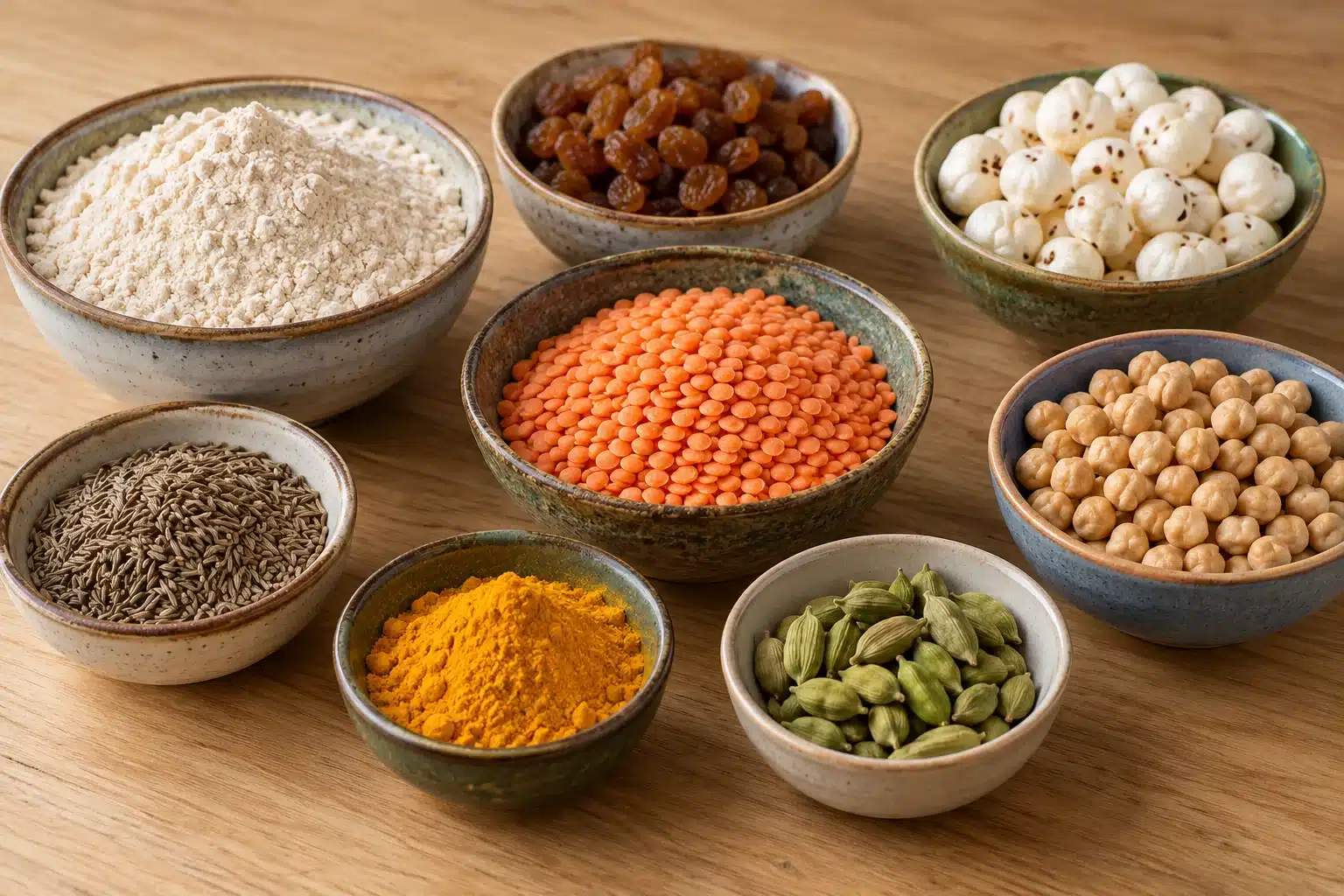
What Is It Called in English and Dutch? An Indian Grocery Translation Guide
In short: Indian ingredient names in English and Dutch become easier to match when you check the ingredient, its form and the label together. Jeera is cumin or komijn; haldi is turmeric or kurkuma. Whole seeds, powders, split pulses and flours are different products, even when part of the name is shared.
A recipe says dhania, the jar says coriander and the Dutch shelf says koriander.
All three may point you in the right direction, but you still need to know whether the recipe wants seeds or leaves.
The same problem appears with dal, flour and familiar-looking black seeds.
Use the names as a starting point, then check the physical form before putting the packet in your basket.
How to use the tables
The first column gives a common Indian shop or recipe name.
Names vary between Hindi, Punjabi, Gujarati and other languages, so the list is a shopping aid rather than a complete language dictionary.
The Dutch column uses an ordinary label where one is clear.
Where a short everyday equivalent is unreliable, it keeps the original name and explains what to look for.
That is more useful than inventing a translation a Dutch shop would not recognise.
Take a photograph of the recipe’s ingredient line if you are unsure.
Include any words such as whole, split, roasted, ground or peeled.
Those words often change the purchase more than the headline name.
A seller cannot reliably infer the right form from the word dal alone.
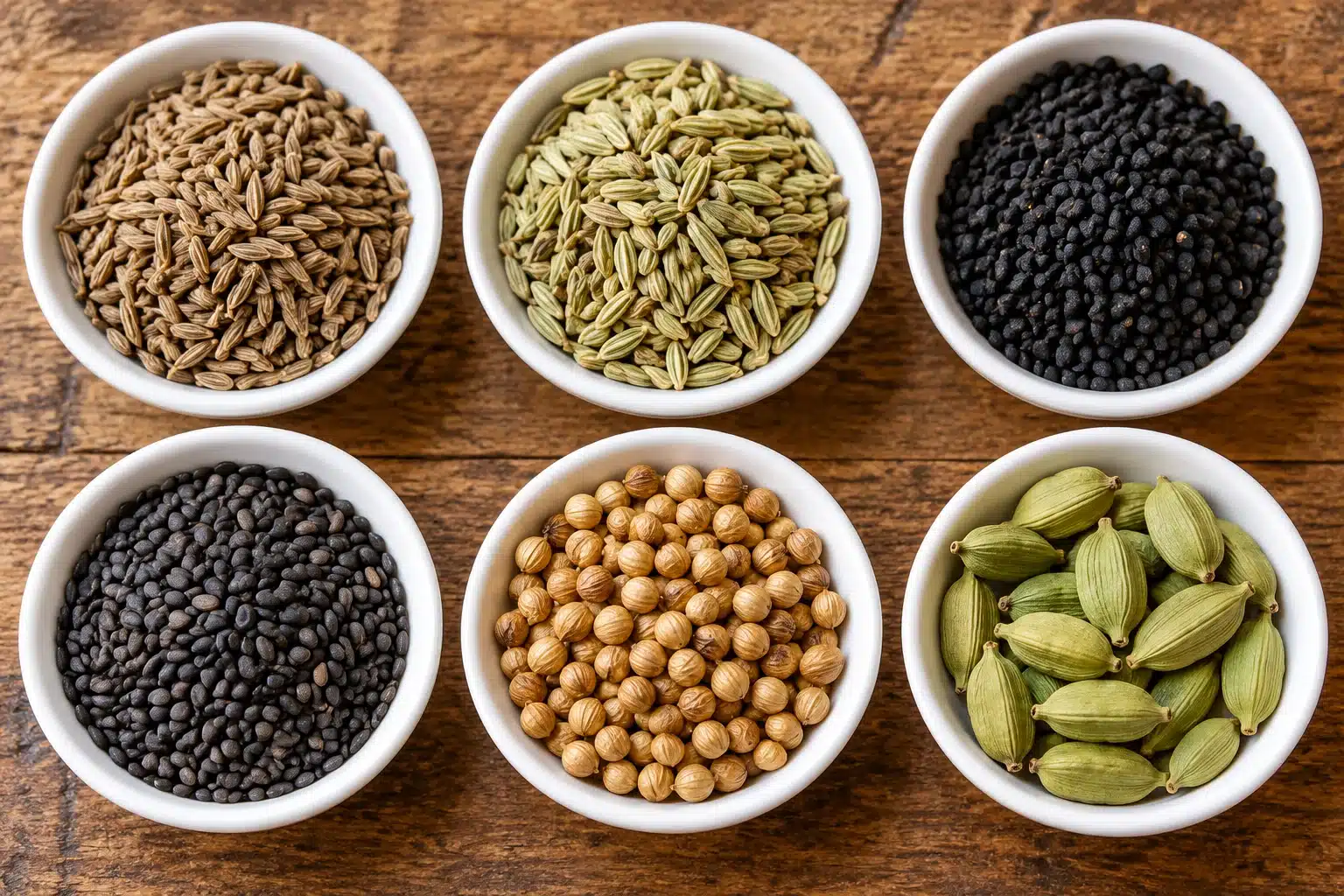
Spices: the name and the form
Look for spices under their Hindi names alongside the English label. Most common spices appear in both whole and ground forms.
A recipe that begins by frying seeds generally needs the whole spice. A powder added to a sauce is a different stage of cooking.
| Indian name | English | Dutch label | Culinary use |
|---|---|---|---|
| Jeera | Cumin | Komijn | Whole in tadka; ground in masala |
| Haldi | Turmeric | Kurkuma | Colour and earthy flavour in sauces |
| Dhania | Coriander seed | Korianderzaad | Whole or ground spice |
| Methi dana | Fenugreek seed | Fenegriekzaad | Small quantities in tempering or pickles |
| Saunf | Fennel seed | Venkelzaad | Sweet aromatic note in spice blends |
| Elaichi, green | Green cardamom | Groene kardemom | Chai, kheer and sweets |
| Dalchini | Cinnamon | Kaneel | Whole in rice; ground in sweets |
| Laung | Clove | Kruidnagel | Rice, chai and spice blends |
| Kali mirch | Black pepper | Zwarte peper | Ground or whole for savoury heat |
| Rai / sarson | Mustard seed | Mosterdzaad | Tempering and pickles |
| Ajwain | Carom seed | Ajwain; check the original label | Savoury doughs and spice mixtures |
| Kalonji | Nigella seed | Nigella / kalonji | Breads, vegetables and pickles |
| Hing | Asafoetida | Asafoetida / hing | Small amounts in tempering |
Curry powder and garam masala are blends, not translations of one single spice. Their ingredients differ between brands and recipes.
Curry leaves are also a separate ingredient, not the leaves of a curry-powder plant. If a recipe lists several individual spices, substituting one spoonful of an unspecified blend changes the result.
It may still be a useful meal, but it is not a word-for-word translation.
For a small starter selection, our spice-rack guide for a Dutch kitchen explains what to buy first. A few clearly labelled packets are easier to cook with than several unmarked jars.
Keep the original label until you are certain you can distinguish similar powders. Colour alone is unreliable.
Pulses: dal is not always a lentil
Dal can refer to a split pulse or to the cooked dish. Chana dal is split chickpea, while masoor dal is a lentil.
Rajma is kidney bean, not a lentil. A recipe calling for urad cannot be matched just by choosing any packet labelled lentils.
| Indian name | English | Dutch shopping description | Check before cooking |
|---|---|---|---|
| Kabuli chana | Chickpeas | Kikkererwten | Dried versus cooked in a tin |
| Chana dal | Split chickpeas | Gespleten kikkererwten | Split pulse, not chickpea flour |
| Masoor dal | Red split lentils | Rode linzen | Whole masoor is a different form |
| Moong | Mung beans | Mungbonen | Whole, split and peeled versions |
| Toor / arhar dal | Split pigeon peas | Toor dal; original label | Do not identify only by yellow colour |
| Urad | Black gram | Urad; original label | Whole black versus split peeled |
| Rajma | Kidney beans | Kidneybonen | Dried versus ready-cooked |
For every dal and pulse, check whether it is whole or split and whether the skin remains. A whole pulse and its peeled split version can have different soaking times and textures.
Do not assume a yellow colour makes two dals interchangeable. Follow the recipe and the packet’s preparation directions.
Tinned chickpeas and dried chickpeas are also different starting points. The tin usually contains cooked chickpeas with liquid.
A dry weight cannot be replaced by the same weight of drained cooked beans without adjusting the recipe. Our guide to choosing Indian dals explains the everyday cooking differences.
The name helps you find the shelf; the form helps you cook dinner.
Flours and grains
Atta, maida and besan do different jobs. Atta is wholemeal wheat flour commonly used for roti.
Maida is refined wheat flour.
Besan is gram flour, made from chickpeas.
Do not read “flour” on an English label and assume any bag will work in a recipe.
| Indian name | English ingredient | Dutch description | Typical use |
|---|---|---|---|
| Atta | Wholemeal wheat flour | Volkoren tarwemeel | Roti and chapati |
| Maida | Refined wheat flour | Tarwebloem | Doughs and fried snacks |
| Besan | Gram / chickpea flour | Kikkererwtenmeel | Pakora, chilla and sweets |
| Sooji / suji | Wheat semolina | Tarwegriesmeel | Halwa; check fine or coarse |
| Bajra | Pearl millet | Bajra; pearl millet on label | Often sold as flour for roti |
| Jowar | Sorghum | Sorghum | Bhakri flour and whole grain |
| Ragi | Finger millet | Ragi; finger millet on label | Flour for porridge or dough |
| Kodri / kodra | Often kodo millet | Check identified packet | Regional name; verify grain |
Choose atta, besan and millet flours by the ingredient and the intended dish. A bag of whole grain needs a different cooking method from a flour made from it.
Millet is a group of grains, not one product. Bajra, ragi and jowar are distinct ingredients.
Kodri needs a second check
Kodri or kodra is often used for kodo millet, but regional names and shop spellings vary. Do not identify a loose grain or a poorly labelled packet from that name alone.
Check the English identification and, when supplied, the botanical name on the package. If the shop has no clearly identified listing, ask rather than buying another small millet as an assumed match.
Availability is separate from translation.
The millet guide for Dutch kitchens explains the differences between the common grains.
Dry fruit, nuts and seeds
“Dry fruit” on a South Asian shopping list can include nuts as well as dried fruit. It is a retail grouping, not a promise that everything in the section is botanically a fruit.
Read the ingredient name when choosing a garnish.
| Indian name | English | Dutch label or description | Useful distinction |
|---|---|---|---|
| Kishmish | Raisins | Rozijnen | Dried grapes, not nuts |
| Charoli / chironji | Chironji seeds | Charoli / chironji | Small kernels used as a garnish |
| Makhana | Popped fox nuts | Makhana; original label | Check plain versus seasoned |
| Magaz | Seed kernels; type varies | Check the specified seed | Do not assume every packet is melon |
The charoli, makhana and other dry fruit section can include ingredients that look unfamiliar outside South Asian cooking.
Charoli and raisins do not perform the same job in a sweet simply because they share a shelf.
Makhana is also not the same thing as popcorn.
Check whether the packet contains a plain ingredient or a seasoned snack before using it in a recipe. A sweet or salted coating can change the whole dish.
Five pairs worth checking twice
Pair 1
- Dhania seed and coriander leaves share a name but have different uses.
- Look for seeds in a dry spice mix and leaves when the recipe calls for a fresh garnish.
- Do not add a handful of whole seeds where a recipe expects chopped leaves.
Pair 2
- Jeera and saunf can look similar at a glance.
- Cumin has a different aroma from fennel.
- Read the packet rather than identifying either from the shape of a few seeds.
Pair 3
- Kalonji and black sesame are different seeds.
- Names such as black cumin can be used inconsistently in trade.
- For kalonji, look for a clearly identified nigella product.
- Do not buy black sesame as a substitute because both seeds are black.
Pair 4
- Sooji, suji and rava can all describe semolina in many recipes.
- However, rava is also used in names for other coarse grain products. Read the ingredient line.
- Dutch griesmeel also needs checking for the grain and coarseness.
- Fine wheat semolina for halwa is not automatically interchangeable with every coarse cereal sold for porridge.
Pair 5
- Finally, elaichi can mean green or black cardamom.
- Green cardamom is common in chai and sweets.
- Black cardamom has a different character and is often used in savoury cooking.
- Check the colour and type when a short recipe simply says cardamom.
Read the whole label before substituting
An ingredient name does not establish suitability for an allergy or dietary requirement.
A blended hing product, for example, may contain a carrier ingredient. A flour mix can contain more than the grain named on the front.
Read the complete list and any relevant allergen statement. Do not assume that a translated name overrides the actual label.
Write the name, form and quantity together on your list. “Jeera, whole seeds” is clearer than “Indian spices”. “Chana dal, dried split pulse” is clearer than “chickpeas” when the recipe requires dal.
These small details save a second shopping trip.
Panjab Supermarket offers same-day delivery across Nieuwegein, Utrecht, Leidsche Rijn, Vleuten, Maarssen, Zeist, Bunnik, IJsselstein, Vianen and Culemborg.
Delivery is a flat 2.49 euros and free on orders over 49 euros.
FAQs
Does gram flour mean flour measured in grams?
No. Gram flour is an ingredient name for chickpea flour, commonly called besan.
Can I substitute a seasoned makhana snack for plain makhana in kheer?
Check the full ingredients first. A savoury coating makes it unsuitable for a straightforward sweet recipe. Keep the useful names on your list, and keep the labels with the food.


You must be logged in to post a comment.