
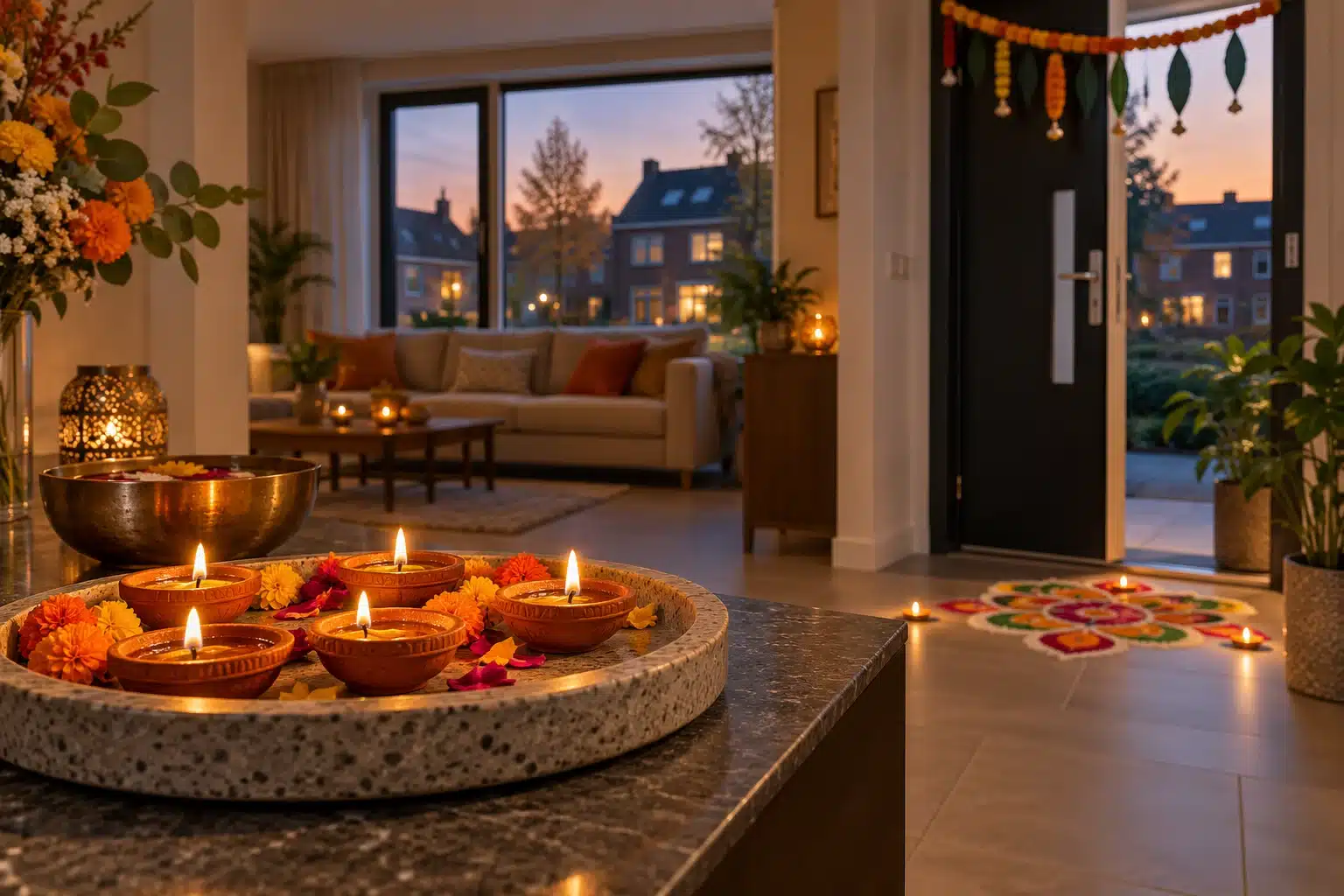
Diwali 2026 in the Netherlands: How to Celebrate Under the Fireworks Ban
In short: Diwali 2026 in the Netherlands falls on Sunday 8 November, after the national consumer fireworks ban took effect on 1 August. F1 fireworks remain an exception, subject to applicable rules. Diyas, rangoli, decorations and shared vegetarian food offer practical ways to celebrate without arranging a private fireworks display.
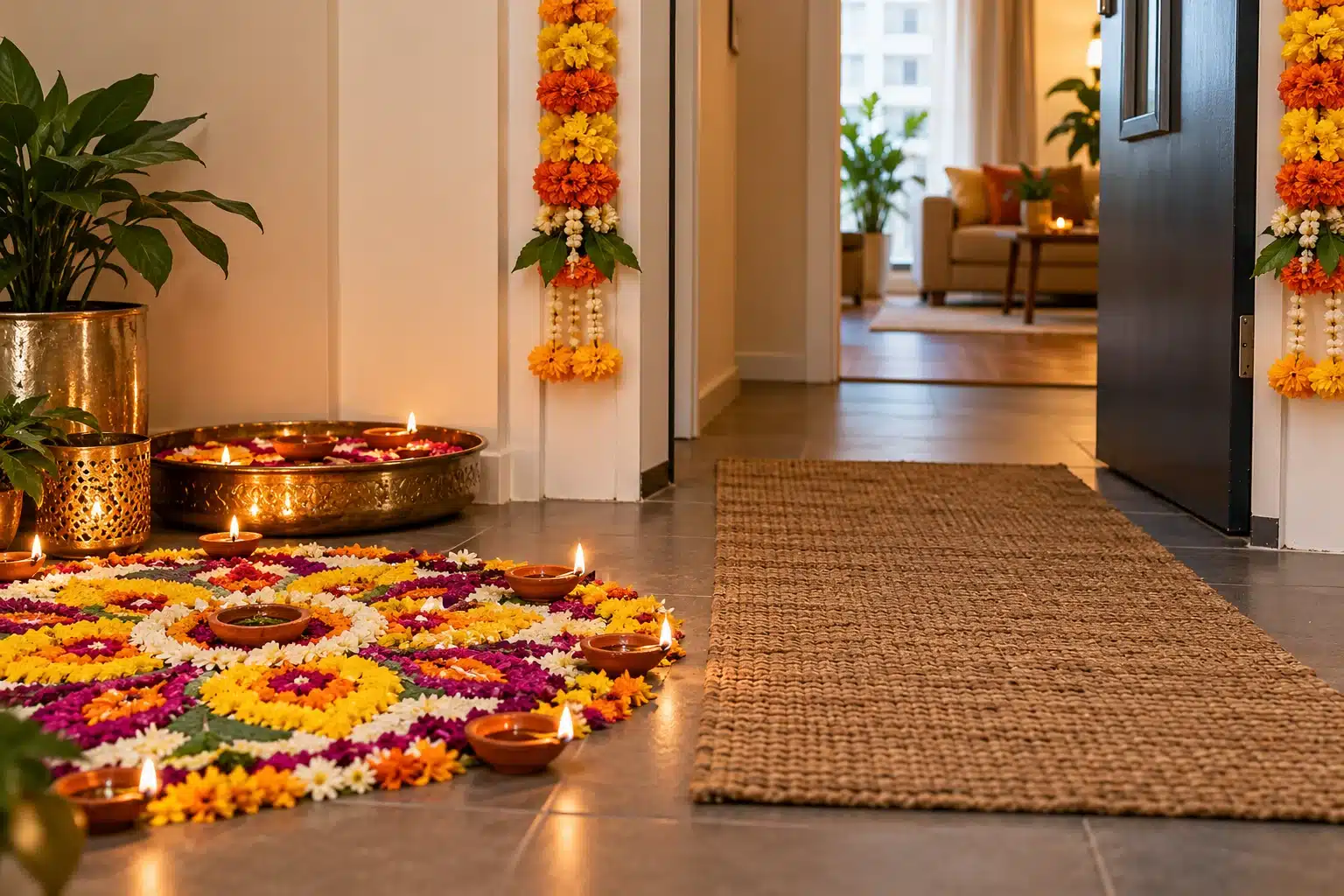
Your doorway can feel festive before a single guest arrives. A small rangoli, a toran above the entrance and a few carefully placed lights do most of the work.
For families in Dutch flats and terraced houses, the useful questions are often about space, neighbours and timing.
You can keep the evening recognisably yours while fitting it to the home you have.
Put the festival dates in the diary
Lakshmi Puja and Diwali fall on Sunday 8 November 2026 in the Amsterdam Hindu calendar.
Related observances belong to a sequence rather than one identical celebration in every household. Dhanteras is associated with preparations and purchases in many families.
Narak Chaturdashi, often called Choti Diwali, comes before the main evening. Govardhan Puja and Bhai Dooj follow in the wider festival period.
Names, observance dates and practices vary by region and calendar convention.
Use your mandir’s local timetable for the observances your household keeps. Do not copy a puja time calculated for Delhi into a Utrecht invitation.
A useful invitation gives guests an arrival time and a separate dinner time. If you plan a family puja before eating, say so plainly.
Guests can then arrive without interrupting a quiet part of the evening.
For the shopping sequence and the existing besan ladoo recipe, use our full Diwali shopping timeline.
Keep that list separate from the small set of tasks needed on the day.
You should not have to buy everything again because a festival checklist is longer than your household’s practice.
What the Dutch fireworks ban changes
Rijksoverheid states that the national consumer fireworks ban took effect on 1 August 2026.
Its guidance identifies category F1 items, such as sparklers, as an exception. That does not make every item sold under a festive name an F1 product.
Check the actual category label and the current rules from your gemeente before buying or using anything.
A private Diwali gathering is not automatically exempt from the rules. The government’s announcement describes a local exemption route for qualifying associations and foundations.
It is a formal process, not permission that an ordinary host can assume. Professional displays have their own requirements.
If an event advertises fireworks, check the organiser’s current information rather than planning your own display alongside it.
Panjab Supermarket does not sell fireworks or sparklers. The shop’s Diwali range is for groceries and festival items.
Do not ask a child to identify a firework by its appearance. If you are unsure what an item is, leave it unused and consult the official guidance.
This article is a planning guide; your municipality’s current instructions are the place to check local restrictions.
Light the entrance without crowding it
Start with the route people actually walk. A diya placed where a coat, shopping bag or child’s sleeve can reach it is poorly placed, however attractive it looks.
Set real flames on stable, heat-resistant trays away from curtains and loose decoration. Keep the exit clear.
Stay with burning lamps and extinguish them before leaving the room or going to bed.
Choose clay and decorated diyas for the part of the evening when someone can supervise them. Use suitable battery lights where a flame would be awkward.
A hallway shelf, balcony railing or shared stairwell needs more thought than a dining table. Check building rules before putting objects in communal areas.
A shared landing still needs to function as everyone’s way out.
Rangoli and toran in a small home
A toran is a decorative hanging for an entrance. Measure the doorway and check the fixing before buying a large one.
Place a rangoli to the side of the walking route so the pattern does not become the route itself.
For a compact arrangement, choose one clear area rather than spreading loose colour across the hall. Browse rangoli kits and torans with that space in mind.
Keep decoration away from the diya tray and use each product for its intended purpose.
A smaller arrangement that stays intact is more welcoming than a large one guests must step over.
Make room for the puja
Clear the surface before arranging flowers, sweets and lamps. Check which items your household uses and who is preparing them.
Keep incense and camphor for the puja away from children and follow the product instructions. Camphor sold for ritual burning is not a cooking ingredient.
Keep smoke alarms active. If fragrance or smoke is a problem for a guest, discuss a suitable arrangement before they arrive.
Do not assume one household’s ritual sequence represents every Hindu family. Sikh and Jain households may also mark this season in distinct ways.
A host can explain their own observance without offering a lesson on everybody else’s. Guests usually need a clear invitation more than a long description.
Food that leaves you time to celebrate
Choose food that does not tie the host to the hob for the whole evening. A curry, dal and rice can carry the meal.
Serve pickle or chutney separately so people can choose their own accompaniment. If you plan fried snacks, decide who will fry them and when.
One freshly cooked item is enough if the rest of dinner is already waiting.
For dessert, Diwali sweets and mithai can supplement what you make at home. Check ingredient labels for milk, nuts and other allergens before dividing sweets among guests.
Keep packaging until everyone has chosen. Do not describe a mixed sweet box as suitable for a particular dietary need without checking the actual items.
Serve a smaller selection clearly rather than mixing everything into one unlabelled bowl.
If you want to join a local gathering
Use the organiser’s current announcement for the date, venue, admission arrangements and programme. An old festival photograph or last year’s social post is not a travel plan.
Check the listing again before leaving home. For a mandir visit, look for the institution’s own schedule and any booking instructions.
Do not assume that a gathering on the preceding weekend takes place on Diwali itself.
If you are bringing Dutch friends, explain what they are attending. A public cultural festival, a temple programme and dinner at home are different occasions.
Let guests know whether they should bring anything and whether shoes come off indoors. Small practical details avoid awkwardness.
A message you can share with neighbours
“We are celebrating Diwali with family on Sunday 8 November. We will have lights and a meal at home, with guests arriving in the evening. Please let us know if you need us to keep the shared entrance clear at a particular time.”
Adapt that message to your actual plans. There is no need to promise a silent evening or explain every tradition.
A clear, friendly heads-up is often enough.
Finish the shopping before the doorway fills
Check lamps, ingredients and serving containers before guests arrive. Buy for your arrangement rather than an imagined large celebration.
Confirm the shop’s current availability and checkout options.
Panjab Supermarket offers same-day delivery across Nieuwegein, Utrecht, Leidsche Rijn, Vleuten, Maarssen, Zeist, Bunnik, IJsselstein, Vianen and Culemborg.
Delivery is a flat 2.49 euros and free on orders over 49 euros.
Two practical questions
Can I put a diya display in the communal stairwell?
Ask the building manager first. Keep escape routes clear and use an alternative location if the building rules do not allow it.
Does a diya set always include the fuel and wicks?
No. Read the contents of the particular pack before ordering, and check what the lamp manufacturer specifies.
Make the light, food and welcome fit your home.




You must be logged in to post a comment.