
Navratri Fasting Food: What to Eat & How to Cook It
In short: Sharad Navratri begins on Sunday 11 October 2026 and runs for nine nights.
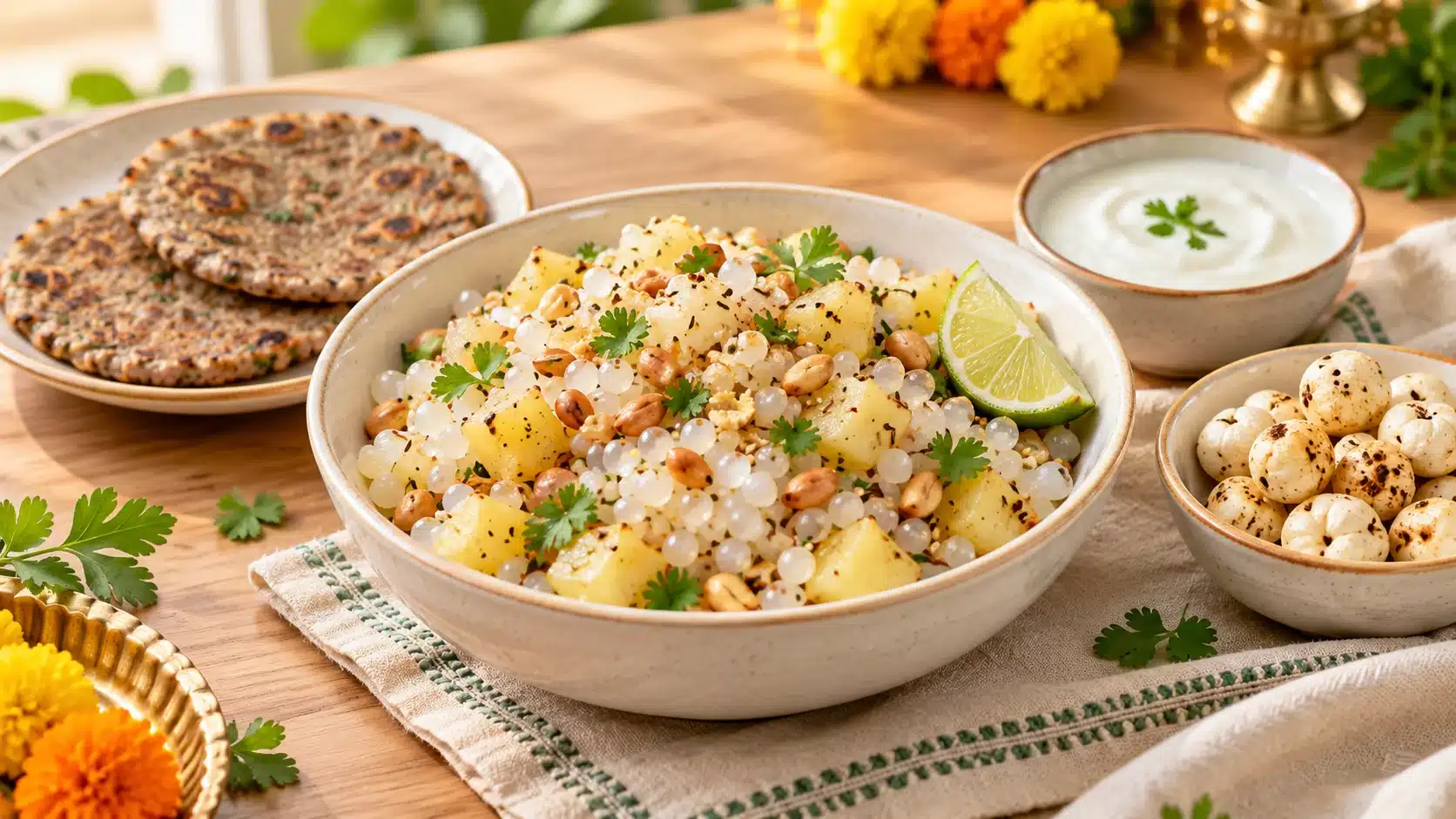
Vrat food commonly swaps wheat and rice for kuttu (buckwheat), singhara (water chestnut) and rajgira (amaranth) flours, with sabudana, potatoes and sendha namak.
Customs differ by family, so follow the practice your household keeps.
Navratri fasting food can look restrictive until you know what replaces everyday flour, rice and salt.
If your household observes vrat, a well-planned pantry makes the cooking simpler.
This guide covers the common choices and how to make sabudana khichdi without turning the pearls into one sticky mass.
What Navratri fasting actually means
There is no single menu followed by every family.
Vrat practice varies by region, community and household.
Some people fast for all nine days, some keep only the first and last days, and others change one meal.
One family may use cumin and tomatoes while another leaves them out.
Treat any food list as a starting point, then follow the custom you know at home.
A common North Indian vrat pantry replaces regular grains and pulses with buckwheat, water chestnut, amaranth, barnyard millet and sabudana.
Potatoes, fruit, dairy, peanuts, nuts, coconut and makhana are also widely used where household practice allows them.
Vrat cooking can still include proper meals rather than nine days of fruit bowls.
The flours you can use
The three names you will meet most often are kuttu atta, singhara atta and rajgira atta.
They do not stretch like wheat dough.
To avoid cracked rotis and crumbling puris, choose the flour for the dish rather than forcing one dough to do everything.
- Kuttu atta is buckwheat flour, or boekweitmeel in Dutch.
Its earthy flavour suits puris, pakoras and rotis.
The dough tears easily, so bind it with mashed boiled potato and roll it between two sheets of baking paper. - Singhara atta is water chestnut flour, or waterkastanjemeel.
Combined with potato, it works for puris, parathas and halwa.
Add water little by little because it can move from dry to sticky quickly. - Rajgira atta is amaranth flour, or amarantmeel.
Its nutty taste suits rotis, puris, ladoos and halwa.
For flatbreads, a warm boiled potato gives the dough enough structure to hold together.
Browse kuttu, singhara and rajgira flours in the flour section and check current availability.
Check the pack name carefully: kuttu is buckwheat, singhara is water chestnut and rajgira is amaranth.
They cook differently even when recipes call them all vrat flour.
Grains and starches that take over the main meal
Sabudana, also called sago or tapioca pearls, is often labelled tapiocaparels in Dutch shops.
It absorbs water before cooking and turns translucent in the pan.
Use it for khichdi, vada or kheer.
The soaking method matters most.
Too much water makes it gummy; too little leaves a hard white centre.
Samak, sanwa, sama and barnyard millet are names you may see for the small seed cooked in place of rice.
It can be simmered as a loose pulao, made into khichdi or cooked with milk for kheer.
Makhana, or fox nuts, needs much less planning.
Toast it slowly in ghee until crisp, then season it according to your household’s vrat practice.
Shop sabudana, samak and makhana before the festival week so you are not looking for substitutes on the day.
What many families leave out
Regular wheat flour, rice and rice flour are commonly set aside during Navratri vrat, along with most lentils and beans.
Many households also avoid onion and garlic.
Ordinary table salt is usually replaced by sendha namak, meaning rock salt or steenzout.
It may be sold as pink salt, but kala namak is a different, sulphurous black salt.
Spice choices are one of the areas where family practice differs most.
Cumin, black pepper, cardamom, cinnamon and fresh ginger are common in many vrat kitchens, but turmeric, hing, mustard seed, chilli blends and ready-made masalas may not fit every household’s custom.
Read mixed-spice labels rather than assuming a familiar blend is suitable.
Check the ingredients of spices for your vrat pantry and confirm that the salt you choose is labelled rock salt and suits your household’s custom.
Do not assume every pink-salt pack is suitable.
Sabudana khichdi for two
The safest approach is to start the soaking four to five hours before you want to eat.
Different batches of sabudana soften at different speeds, so the finger test matters more than the clock.
A ready pearl should crush completely between your thumb and finger, with no hard centre.
Ingredients
- 1 cup sabudana
- 3/4 cup water for soaking, plus a little extra only if needed
- 1 medium potato, boiled, peeled and cut into small cubes
- 1/3 cup roasted peanuts, roughly crushed
- 1 tablespoon ghee or cooking oil
- 1 teaspoon cumin seeds, if used in your household
- 1 small green chilli, finely chopped, if used
- Sendha namak to taste
- 1 tablespoon lime juice
- Chopped coriander to finish, if used
- Put the sabudana in a bowl, cover it with cold water and rub the pearls gently.
Drain.
Repeat two or three times until the draining water is mostly clear.
This removes loose surface starch. - Add 3/4 cup fresh water, cover and leave for four to five hours.
The pearls should absorb the water rather than float in it.
Check one by pressing it between your fingers.
If the centre is still hard, sprinkle over one or two tablespoons of water and rest for another 30 minutes. - Tip the soaked sabudana into a colander and drain it fully for 10 to 15 minutes.
Mix in the crushed peanuts and sendha namak.
The peanut coating also helps keep the pearls separate. - Heat the ghee in a wide pan.
Add cumin and green chilli if you use them, then add the potato.
Cook until the edges of the potato take on a little colour. - Add the sabudana mixture.
Cook over medium-low heat for five to seven minutes, folding gently rather than stirring constantly.
Stop when most pearls look translucent.
Cooking longer will make them sticky. - Turn off the heat, add lime juice and coriander if used, and serve straight away.
If the khichdi clumps, look at the soaking stage first.
Excess water, incomplete draining and overcooking are the usual causes.
If the pearls remain white and hard in the centre, they needed more soaking time, not more time in the hot pan.
A day of vrat food, planned before you start
Planning one main cooked meal keeps the day manageable.
Breakfast could be fruit with yoghurt and a few nuts, or a small bowl of leftover samak kheer.
For lunch, make sabudana khichdi or a samak pulao with potato and serve it with plain yoghurt.
In the evening, roast makhana in a little ghee or have fruit.
Dinner can be a kuttu or rajgira roti with a simple potato or pumpkin preparation.
Group the preparation jobs.
Boil potatoes once for flatbread dough and khichdi, roast a batch of peanuts, and measure tomorrow’s sabudana before clearing the evening kitchen.
This avoids the two common problems: forgetting the soak and expecting vrat flour to behave like wheat dough.
Your Navratri shopping list and delivery
Start with one vrat flour, sabudana or samak, sendha namak, potatoes, peanuts, makhana, ghee, yoghurt, fruit and the spices accepted at home.
Add coconut, jaggery and nuts for kheer, halwa or ladoos.
You can stock up in one order rather than rebuilding the pantry meal by meal.
Panjab Supermarket delivers the same day across Nieuwegein, Utrecht, Leidsche Rijn, Vleuten, Maarssen, Zeist, Bunnik, IJsselstein, Vianen and Culemborg.
Delivery is a flat 2.49 euros and free on orders over 49 euros.
Check stock and delivery options at checkout.
Ordering the dry ingredients before your first fasting day leaves only fruit, dairy and fresh vegetables to organise.
Two practical questions
Can I soak sabudana overnight instead of for four to five hours?
Yes.
Use only the measured water, cover the bowl and check the pearls in the morning.
If water remains at the bottom, drain the sabudana for 10 to 15 minutes before cooking.
Do not leave it sitting in a large bowl of water overnight.
Is sendha namak the same as Himalayan pink salt?
Sendha namak means rock salt, and many pink-salt packs are rock salt.
For vrat cooking, read the pack rather than relying on colour alone, and do not confuse it with kala namak.
Follow your household’s custom when cooking for other people.
A calm vrat kitchen is mostly good timing: know your flour, measure the soaking water and keep the family’s own practice at the centre.



You must be logged in to post a comment.